Cryptocurrency
Table of Contents
Cryptocurrency
Cryptocurrencies are a new and exciting technology with the potential to change the financial system as we know it. Nevertheless, there remains a lot of uncertainty regarding how they will be utilised in the future.
What is cryptocurrency?
A digital or virtual money that employs cryptography for security is called cryptocurrency. The term “crypto” refers to the numerous cryptographic methods that protect these entries, such as hashing, public-private key pairings, and elliptical curve encryption.
Since cryptocurrencies are decentralised, As such neither a government nor a financial institution can control them. The earliest and best-known cryptocurrency, Bitcoin, was developed in 2009. On decentralised exchanges, cryptocurrency is often exchanged and may be used to make purchases of products and services.
Understanding cryptocurrency
Cryptocurrencies are powered by blockchain technology. Cryptocurrencies are powered by blockchain technology. Blockchain is a digital ledger of all of the cryptocurrency transactions. Blockchain technology is used to secure and track transactions. Bitcoin, for example, uses a blockchain to track and verify all transactions on the Bitcoin network.
Popular cryptocurrencies include litecoin, bitcoin, monero and ether. Cryptographic methods, which are maintained and verified through a process called mining, a network of computers or specialised hardware, such as application-specific integrated circuits (ASICs), process and validate the transactions, and cryptocurrencies are generated (and secured). The procedure rewards the miners who power the Bitcoin network.
Cryptocurrency assets are often volatile, meaning their prices can fluctuate dramatically. This volatility can make cryptocurrencies a risky investment. However, some believe the volatility will decrease as the market matures.
Types of cryptocurrency
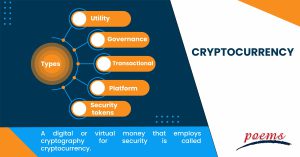
Knowing the different kinds of cryptocurrencies is important, as so many are available nowadays. Knowing if the coin you’re considering serves a purpose will help you evaluate whether investing in it is worthwhile; a cryptocurrency without a use case is riskier than one with one.
Typically, the coin’s name is included while discussing different cryptocurrency varieties. But coin kinds and coin names are different. The following are some of the categories of tokens you could encounter, along with their names:
- Utility
Tokens with this feature include XRP and ETH. On their blockchains, they perform certain roles.
- Governance
These tokens on a blockchain like Uniswap reflect voting or other privileges.
- Transactional
Tokens made to be used as a form of payment. Of these, Bitcoin is the most well-known.
- Platform
These tokens serve programs designed to work with a blockchain like Solana.
- Security tokens
Tokens that reflect ownership of an asset, such as a tokenized stock, are known as security tokens (value transferred to the blockchain). A securitized token is the MS Token, for instance. The Millennium Sapphire may be partially acquired if you can locate one for sale.
Cryptocurrency – how it is produced
Blockchain, a decentralised public ledger updated and maintained by currency holders, is the technology that underlies cryptocurrencies.
The process of “mining,” employing computers’ power to solve challenging mathematical problems to produce coins, is how cryptocurrency units are produced. Additionally, users may purchase the currency from brokers, keep them in encrypted wallets, and then use them to make purchases.
Cryptocurrency ownership entails the lack of any material possessions. What you hold is a key that permits you to move information or a unit of measurement from one person to another without the aid of a trustworthy third party.
Examples cryptocurrency
Examples of cryptocurrencies include:
- Bitcoin
Bitcoin, the first and most prominent cryptocurrency, was created in 2009. The currency’s creator is commonly thought to be Satoshi Nakamoto, an alias for a person or team whose exact identity is still unknown.
- Ethereum
Ethereum, another popular cryptocurrency, was created in 2015. Ethereum differs from Bitcoin in that it allows for smart contracts or contracts that can be executed automatically according to certain conditions.
- Litecoin
Litecoin, another popular cryptocurrency, was created in 2011. In many aspects, Litecoin and Bitcoin are similar, but it is designed to be faster and cheaper to transact.
- Bitcoin cash
It is a fork of Bitcoin, created in 2017. Bitcoin Cash is similar to Bitcoin but has a larger block size, meaning it can process more transactions per second.
Risk Disclosure Statement
The Customer should undertake transactions in futures/ options only when understanding the nature of the contracts (and contractual relationships) into which the Customer is entering and the extent of own exposure to the risks. Trading in futures/ options may not be suitable for everyone. The Customer should carefully consider whether such trading is appropriate for you in the light of your experience, objectives, financial resources and other relevant circumstances. In considering whether to trade, the Customer should be aware of the following, in addition to the risk factors disclosed above:
(14a) Futures, OTCD currency contracts and Spot LFX trading contracts
(i) Effect of ‘Leverage’ or ‘Gearing’
Transactions in futures, OTCD currency contracts and Spot LFX trading contracts carry a high degree of risk. The amount of initial margin is small relative to the value of the futures contract, OTCD currency contract or Spot LFX trading contract transaction so that the transaction is highly ‘leveraged’ or ‘geared’. A relatively small market movement will have a proportionately larger impact on the funds deposited or will have to deposit by the Customer; this may work against or for the Customer. The Customer may sustain a total loss of the initial margin funds and any additional funds deposited with the firm to maintain the position. If the market moves against the position or margin levels are increased, the Customer may be called upon to pay substantial additional funds on short notice in order to maintain the position. If the Customer fail to comply with a request for additional funds within the specified time, the position may be liquidated at a loss and the Customer will be liable for any resulting deficit in the account.
(ii) Risk-Reducing Orders or Strategies
The placing of certain orders (e.g. ‘stop-loss’ orders, where permitted under local law, or ‘stop-limit’ orders) which are intended to limit losses to certain amounts may not be effective because market conditions may make it impossible to execute such orders. At times, it is also difficult or impossible to liquidate a position without incurring substantial losses. Strategies using combinations of positions, such as ‘spread’ and ‘straddle’ positions may be as risky as taking simple ‘long’ or ‘short’ positions.
(14b) Options
(i) Variable Degree of Risk
Transactions in options carry a high degree of risk. Purchasers and sellers of options should familiarise themselves with the type of options (i.e. put or call) which the Customer contemplate trading and the associated risks. The Customer should calculate the extent to which the value of the options would have to increase for the position to become profitable, taking into account the premium paid and all transaction costs.
The purchaser of options may offset its position by trading in the market or exercise the options or allow the options to expire. The exercise of an option results either in a cash settlement or in the purchaser acquiring or delivering the underlying interest. If the option is on a futures contract, OTCD currency contract or Spot LFX trading contract, the purchaser will have to acquire a position in the futures contract, OTCD currency contract or Spot LFX trading contract, as the case may be, with associated liabilities for margin (see the section on Futures, OTCD currency contracts and Spot LFX trading contracts above). If the purchased options expire worthless, the Customer will suffer a total loss of the investment which will consist of the option premium paid plus transaction costs. If the Customer is contemplating purchasing deep-out-of-the-money options, the Customer should be aware that, ordinarily, the chance of such options becoming profitable is remote.
Selling (‘writing’ or ‘granting’) an option generally entails considerably greater risk than purchasing options. Although the premium received by the seller is fixed, the seller may sustain a loss well in excess of the amount of premium received. The seller will be liable to deposit additional margin to maintain the position if the market moves unfavourably. The seller will also be exposed to the risk of the purchaser exercising the option and the seller will be obligated to either settle the option in cash or to acquire or deliver the underlying interest. If the option is on a futures contract, OTCD currency contract or spot LFX trading contract, the seller will acquire a position in the futures contract, OTCD currency contract or spot LFX trading contract, as the case may be, with associated liabilities for margin (see the section on Futures, OTCD currency contracts and Spot LFX trading contracts above). If the option is ‘covered’ by the seller holding a corresponding position in the underlying futures contract, OTCD currency contract, spot LFX trading contract or another option, the risk may be reduced. If the option is not covered, the risk of loss can be unlimited.
Certain exchanges in some jurisdictions permit deferred payment of the option premium, limiting the liability of the purchaser to margin payments not exceeding the amount of the premium. The purchaser is still subject to the risk of losing the premium and transaction costs. When the option is exercised or expires, the purchaser is responsible for any unpaid premium outstanding at that time.
(14c) Additional Risks Common to Futures, Options and Leveraged Foreign Exchange Trading
(i) Terms and Conditions of Contracts
The Customer should ask for the terms and conditions of the specific futures contract, option, OTCD currency contract or spot LFX trading contract which the Customer is trading and the associated obligations (e.g. the circumstances under which the Customer may become obligated to make or take delivery of the underlying interest of a futures contract, OTCD currency contract or spot LFX trading contract transaction and, in respect of options, expiration dates and restrictions on the time for exercise). Under certain circumstances, the specifications of outstanding contracts (including the exercise price of an option) may be modified by the exchange or clearing house to reflect changes in the underlying interest.
(ii) Suspension or Restriction of Trading and Pricing Relationships
Market conditions (e.g. illiquidity) or the operation of the rules of certain markets (e.g. the suspension of trading in any contract or contract month because of price limits or ‘circuit breakers’) may increase the risk of loss by making it difficult or impossible to effect transactions or liquidate/offset positions. If the Customer have sold options, this may increase the risk of loss. Further, normal pricing relationships between the underlying interest and the futures contract, and the underlying interest and the option may not exist. This can occur when, e.g., the futures contract underlying the option is subject to price limits while the option is not. The absence of an underlying reference price may make it difficult to judge ‘fair’ value.
(iii) Deposited Cash and Property
The Customer should familiarise with the protection accorded to any money or other property which the Customer deposit for domestic and foreign transactions, particularly in a firm’s insolvency or bankruptcy. The extent to which the Customer may recover such money or property may be governed by specific legislation or local rules. In some jurisdictions, property which had been specifically identifiable as the Customer’s own will be pro-rated in the same manner as cash for purposes of distribution in the event of a shortfall.
(14d) Commission and Other Charges
Before begin to trade, the Customer should obtain a clear explanation of all commissions, fees and other charges. These charges will affect the net profit (if any) or increase loss which the Customer will be entitled or liable respectively.
(14e) Transactions in Other Jurisdictions
Transactions on markets in other jurisdictions, including markets formally linked to a domestic market, may expose the Customer to additional risk. Such markets may be subject to a rule which may offer different or diminished investor protection. Before trading, the Customer should enquire about any rules relevant to the particular transactions. The Customer’s local regulatory authority will be unable to compel the enforcement of the rules of the regulatory authorities or markets in other jurisdictions where the transactions have been effected. The Customer should ask the firm with for such transactions’ details about the types of redress available in both the Customer’s home jurisdiction and other relevant jurisdictions before starting to trade.
(14f) Currency Risks
The profit or loss in transactions in foreign currency-denominated futures and options contracts (whether they are traded in the Customer’s own or another jurisdiction) will be affected by fluctuations in currency rates where there is a need to convert from the currency denomination of the contract to another currency.
(14g) Trading Facilities
Most open-outcry and electronic trading facilities are supported by computer-based component systems for the order-routing, execution, matching, registration or clearing of trades. As with all facilities and systems, they are vulnerable to temporary disruption or failure. The Customer’s ability to recover certain losses may be subject to limits on liability imposed by the one or more parties, namely the system provider, the market, the clearing house or member firms. Such limits may vary. The Customer should ask the firm for such transactions’ details in this respect.
(14h) Electronic Trading
Trading on an electronic trading system may differ not only from trading in an open outcry market but also from trading on other electronic trading systems. If the Customer undertake transactions on an electronic trading system, the Customer will be exposed to risks associated with the system including the failure of hardware and software. The result of any system failure may be that the Order is either not executed according to the communication of the Customer or not executed at all.
(14i) Off-Exchange Transactions
In some jurisdictions, firms are permitted to effect off-exchange transactions. The firm with which the Customer conduct the transactions may be acting as the Customer’s counterparty to the transaction. It may be difficult or impossible to liquidate an existing position, to assess the value, to determine a fair price or to assess the exposure to risk. For these reasons, these transactions may involve increased risks. Off-exchange transactions may be less regulated or subject to a separate regulatory regime. Before the Customer undertake such transactions, the Customer should familiarise with the applicable rules and attendant risks.
(14j) Payment Token Derivatives (PTDs)
Transactions in PTDs such as Cryptocurrency Futures carry a high degree of risk, and may not be suitable for all investors. Losses may exceed deposits. Do conduct due diligence and consult financial advisor before making any trading decisions. The Customer should carefully consider whether such trading is appropriate in the light of its experience, objectives, financial resources and other relevant circumstances. In considering to trade, the Customer should be aware of the following risks, which include but are not limited to:
(i) Lack of Legislative Protection by Monetary Authority of Singapore (MAS)
Cryptocurrencies are not legal tender and are not issued by any government nor backed by any asset or issuer. Cryptocurrencies are currently not subjected to any regulatory requirements or supervisory oversight by the MAS. Hence, the safeguards afforded under MAS’ regulatory framework will not apply to consumers dealing with unregulated products, such as CFDs on Cryptocurrencies.
(ii) Extreme Volatility
Cryptocurrencies have little or no intrinsic value, making them hard to value and extremely volatile. Being highly speculative, investing in cryptocurrencies entails high risks as prices are prone to sharp, sudden swings as a result of unanticipated events or changes in market sentiments primarily due to the lack of price transparency.
(iii) Liquidity Risks and Price Slippages
Cryptocurrencies is a relatively new asset class and regulations, or a lack thereof, may have an impact on liquidity which in turn may result in unwanted price slippages. This is exacerbated in times of market volatility.
Possible failure of cryptocurrency exchanges may also increase illiquidity.
(iv) Cybersecurity Risks
Being a virtual, decentralized currency with no overarching regulatory body, cryptocurrency intermediaries are vulnerable to security breaches and market manipulations. Technical glitches on cryptocurrency intermediaries may happen as well. Such scenarios may cause disruption to trading and may cause substantial volatility in prices.
(v) Hard Forks
A hard fork changes the software, making it not backward compatible. Blocks running the new software will not be recognized and work with users running the older software, essentially splitting a single cryptocurrency into two. Hard forks may cause substantial volatility in prices.
Exchanges may in its sole discretion, take alternative action with respect to hard forks in consultation with market participants as may be appropriate.
Phillip Nova will endeavor to inform Customers of any hard forks but it is ultimately the Customer’s responsibility to be aware of them.
(vi) Weekend Gap Risk on Cryptocurrencies
Major cryptocurrencies trade 24 hours including weekends. However, Cryptocurrency Futures offered by Phillip Nova are not tradable on weekends and have specific trading hours. This may result in wide price gaps when the market opens after weekends that experienced market volatility.
Trading in PTDs such as futures contracts, cryptocurrency CFDs, debentures and/or collective investment schemes such as funds and ETFs that reference digital payment tokens (or cryptocurrencies) carries a high level of risk. The Customer runs the risk of losing all of their invested capital, or potentially more.The customer must be fully aware of the following risks associated with both derivatives and products that invest in cryptocurrencies, and carefully assess whether these products are suitable for their investment objectives and risk appetite:
(i) Lack of Legislative Protection by Monetary Authority of Singapore (MAS)
Cryptocurrencies have a wide range of attributes, characteristics and features and most cryptocurrencies fall outside of the ambit of the Payment Services Act. Therefore, the safeguards afforded under the Monetary Authority of Singapore (MAS) regulatory framework may not apply to investors dealing in unregulated products such as these cryptocurrencies.
(ii) Extreme Volatility
Cryptocurrencies have no central authority and are not backed by any government, have little or no intrinsic value, and exhibit high volatility. PTDs and investment products with exposure or investments in cryptocurrencies are prone to sudden sharp swings as a result of unanticipated events or changes in market sentiments primarily due to the lack of price transparency;
(iii) Liquidity Risks
Liquidity may also become limited and price gaps may occur in such circumstances;
(iv) Cybersecurity Risks
Cryptocurrency exchanges, where cryptocurrencies are bought and traded, may be susceptible to cyber security breaches. In the event of a cyberattack and theft of cryptocurrencies, it may result in drastic, adverse price movements.
Frequently Asked Questions
Generally, use these easy steps to purchase cryptocurrency:
- Select a broker or cryptocurrency exchange
- Register for an account and verify it
- Deposit money to invest
- Place your order for cryptocurrency
- Pick a storage approach
You may purchase cryptocurrencies using alternative methods, such as:
It is important to consider if the popularity that cryptocurrencies have achieved over time is real. Cryptocurrency, particularly Bitcoin, has, even though it is still far from replacing institutionalised cash, gained widespread acceptability worldwide.
They can be used as a mode of payment. Bitcoin was initially of limited value as a method of payment to retailers. But over time, many businesses, including eateries, airlines, jewellers, and apps, have begun to recognise it as a legitimate form of payment.
Additionally, cryptocurrencies, particularly Bitcoin, are among the most profitable investment opportunities available. Its value growth is dynamic and may be a great route for capital growth.
The price of cryptocurrencies is highly volatile and can change rapidly. Governments or financial institutions do not regulate cryptocurrencies, so their value is determined by supply and demand on the open market. The price of a cryptocurrency is also influenced by factors such as media coverage, public interest, and even rumours.
Bitcoins are kept in a digital wallet, just like we store credit cards or cash in a physical wallet. Digital wallets can be web-based or hardware-based. The wallet can be stored on a desktop computer or mobile device or kept secure by writing the private keys and access addresses on paper.
Some of the safest methods to keep cryptocurrency are in custodial and hardware wallets, but each has benefits and limitations.
For certain companies, the use of cryptocurrencies may present opportunities. The advantages might include the following:
- A crypto transaction often happens quickly. For instance, only a computer or smartphone is required to move Bitcoins from one digital wallet to another.
- Cheaper and quicker money transactions and decentralised networks that do not have a sole point of failure are two benefits of cryptocurrencies.
- Blockchain seeks to eliminate middlemen like banks and internet marketplaces, so there are no transaction costs.
- Payments made using cryptocurrencies are becoming more common among big businesses and industries like fashion and medicine.
Cryptocurrencies’ drawbacks include their unstable prices, high energy requirements for mining, and usage in illegal activities. Additionally, cyber attacks often target cryptocurrency exchanges, which might mean that you permanently lose your investments.
Related Terms
- Compound Yield
- Discretionary Accounts
- Industry Groups
- Growth Rate
- Foreign Direct Investment (FDI)
- Floating Dividend Rate
- Real Return
- Non-Diversifiable Risk
- Liability-Driven Investment (LDI)
- Guaranteed Investment Contract (GIC)
- Flash Crash
- Cost Basis
- Deferred Annuity
- Cash-on-Cash Return
- Bubble
- Compound Yield
- Discretionary Accounts
- Industry Groups
- Growth Rate
- Foreign Direct Investment (FDI)
- Floating Dividend Rate
- Real Return
- Non-Diversifiable Risk
- Liability-Driven Investment (LDI)
- Guaranteed Investment Contract (GIC)
- Flash Crash
- Cost Basis
- Deferred Annuity
- Cash-on-Cash Return
- Bubble
- Asset Play
- Accrued Market Discount
- Inflation Hedge
- Incremental Yield
- Holding Period Return
- Hedge Effectiveness
- Fallen Angel
- EBITDA Margin
- Dollar Rolls
- Dividend Declaration Date
- Distribution Yield
- Derivative Security
- Fiduciary
- Current Yield
- Core Position
- Cash Dividend
- Broken Date
- Share Classes
- Valuation Point
- Breadth Thrust Indicator
- Book-Entry Security
- Bearish Engulfing
- Core inflation
- Approvеd Invеstmеnts
- Allotment
- Annual Earnings Growth
- Solvency
- Impersonators
- Reinvestment date
- Volatile Market
- Trustee
- Sum-of-the-Parts Valuation (SOTP)
- Proxy Voting
- Passive Income
- Diversifying Portfolio
- Open-ended scheme
- Capital Gains Distribution
- Investment Insights
- Discounted Cash Flow (DCF)
- Portfolio manager
- Net assets
- Nominal Return
- Systematic Investment Plan
- Issuer Risk
- Fundamental Analysis
- Account Equity
- Withdrawal
- Realised Profit/Loss
- Unrealised Profit/Loss
- Negotiable Certificates of Deposit
- High-Quality Securities
- Shareholder Yield
- Conversion Privilege
- Cash Reserve
- Factor Investing
- Open-Ended Investment Company
- Front-End Load
- Tracking Error
- Replication
- Real Yield
- DSPP
- Bought Deal
- Bulletin Board System
- Portfolio turnover rate
- Reinvestment privilege
- Initial purchase
- Subsequent Purchase
- Fund Manager
- Target Price
- Top Holdings
- Liquidation
- Direct market access
- Deficit interest
- EPS forecast
- Adjusted distributed income
- International securities exchanges
- Margin Requirement
- Pledged Asset
- Stochastic Oscillator
- Prepayment risk
- Homemade leverage
- Prime bank investments
- ESG
- Capitulation
- Shareholder service fees
- Insurable Interest
- Minority Interest
- Passive Investing
- Market cycle
- Progressive tax
- Correlation
- NFT
- Carbon credits
- Hyperinflation
- Hostile takeover
- Travel insurance
- Money market
- Dividend investing
- Digital Assets
- Coupon yield
- Counterparty
- Sharpe ratio
- Alpha and beta
- Investment advisory
- Wealth management
- Variable annuity
- Asset management
- Value of Land
- Investment Policy
- Investment Horizon
- Forward Contracts
- Equity Hedging
- Encumbrance
- Money Market Instruments
- Share Market
- Opening price
- Transfer of Shares
- Alternative investments
- Lumpsum
- Derivatives market
- Operating assets
- Hypothecation
- Accumulated dividend
- Assets under management
- Endowment
- Return on investment
- Investments
- Acceleration clause
- Heat maps
- Lock-in period
- Tranches
- Stock Keeping Unit
- Real Estate Investment Trusts
- Prospectus
- Turnover
- Tangible assets
- Preference Shares
- Open-ended investment company
- Ordinary Shares
- Leverage
- Standard deviation
- Independent financial adviser
- ESG investing
- Earnest Money
- Primary market
- Leveraged Loan
- Transferring assets
- Shares
- Fixed annuity
- Underlying asset
- Quick asset
- Portfolio
- Mutual fund
- Xenocurrency
- Bitcoin Mining
- Option contract
- Depreciation
- Inflation
- Options
- Fixed income
- Asset
- Reinvestment option
- Capital appreciation
- Style Box
- Top-down Investing
- Trail commission
- Unit holder
- Yield curve
- Rebalancing
- Vesting
- Private equity
- Bull Market
- Absolute Return
- Leaseback
- Impact investing
- Venture Capital
- Buy limit
- Asset stripper
- Volatility
- Investment objective
- Annuity
- Sustainable investing
- Face-amount certificate
- Lipper ratings
- Investment stewardship
- Average accounting return
- Asset class
- Active management
- Breakpoint
- Expense ratio
- Bear market
- Hedging
- Equity options
- Dollar-Cost Averaging (DCA)
- Due Diligence
- Contrarian Investor
Most Popular Terms
Other Terms
- Bond Convexity
- Brokerage Account
- Green Bond Principles
- Gamma Scalping
- Funding Ratio
- Free-Float Methodology
- Flight to Quality
- Protective Put
- Perpetual Bond
- Option Adjusted Spread (OAS)
- Merger Arbitrage
- Income Bonds
- Equity Carve-Outs
- Cost of Equity
- Earning Surprise
- Capital Adequacy Ratio (CAR)
- Beta Risk
- Bear Spread
- Ladder Strategy
- Junk Status
- Intrinsic Value of Stock
- Interest-Only Bonds (IO)
- Interest Coverage Ratio
- Industry Groups
- Industrial Bonds
- Income Statement
- Historical Volatility (HV)
- Flat Yield Curve
- Exotic Options
- Execution Risk
- Exchange-Traded Notes
- Event-Driven Strategy
- Eurodollar Bonds
- Enhanced Index Fund
- Embedded Options
- Dynamic Asset Allocation
- Dual-Currency Bond
- Downside Capture Ratio
- Dividend Capture Strategy
- Depositary Receipts
- Delta Neutral
- Deferment Payment Option
- Dark Pools
- Death Cross
- Debt-to-Equity Ratio
- Fixed-to-floating rate bonds
- First Call Date
- Financial Futures
- Firm Order
- Credit Default Swap (CDS)
Know More about
Tools/Educational Resources
Markets Offered by POEMS
Read the Latest Market Journal

Unlock Hidden Income in Your Portfolio
Did you know that the shares sitting in your portfolio can generate additional income—without you needing to sell them? Securities lending gives investors the opportunity to earn extra returns on their existing investments by lending their shares to other market participants for a fee. It is a widely used practice in global financial markets and can help you maximise the value of your portfolio. What Is Securities Lending? Securities lending allows you to temporarily lend your shares to borrowers (such as institutional investors or traders) who require them for trading or investment purposes. In return, you receive: Lending income – Earn a fee while your shares are on loan Collateral protection – Your loan is backed by collateral, which is monitored daily Continued market exposure – You still benefit from price movements of your shares This means your portfolio continues to work for you—even when you are not actively trading. Why Do Borrowers Need Your Shares? Borrowing demand comes from various market activities, including: Short selling - When investors expect prices to fall Market making – To provide liquidity in the market Hedging strategies – To manage risk across investment positions These activities are essential to keeping markets efficient and liquid, while creating opportunities for investors like you to earn additional income. Interesting Facts About Securities Lending Not all stocks earn the same lending returns Some stocks are in higher demand and can generate significantly higher fees Demand can fluctuate depending on market trends, news, or corporate events Stocks with limited supply or high short interest are often more valuable to lend In the market, stocks are often classified as: General Collateral (GC) – Commonly available stocks with steady but lower returns “Hot” Stocks (Specials) – Rare or high-demand stocks that can generate premium lending income Opportunity: High-Demand (“Hot”) Stocks At times, certain stocks experience strong borrowing demand due to: Corporate actions, such as mergers or index changes Market speculation or short interest Tight supply in the market When your holdings fall into this category, you may enjoy higher lending income without making any change to your investment strategy. Why Consider Securities Lending? Generate passive income from your existing holdings Enhance overall portfolio yield No need to actively manage trades Benefit from opportunities when demand spikes Getting Started Securities lending can be seamlessly integrated into your account. With your consent, eligible shares can be made available for lending, and any income earned will be credited to your account on a monthly basis. Simply open SBL account on poems.com.sg Alternatively, you may reach out to our team at sbl@phillip.com.sg for a personalised review and guidance on how to maximise your lending opportunities. Disclaimer These commentaries are intended for general circulation and do not have regard to the specific investment objectives, financial situation and particular needs of any person. Accordingly, no warranty whatsoever is given and no liability whatsoever is accepted for any loss arising whether directly or indirectly as a result of any person acting based on this information. You should seek advice from a financial adviser regarding the suitability of any investment product(s) mentioned herein, taking into account your specific investment objectives, financial situation or particular needs, before making a commitment to invest in such products. Opinions expressed in these commentaries are subject to change without notice. Investments are subject to investment risks including the possible loss of the principal amount invested. The value of units in any fund and the income from them may fall as well as rise. Past performance figures as well as any projection or forecast used in these commentaries are not necessarily indicative of future or likely performance. Phillip Securities Pte Ltd (PSPL), its directors, connected persons or employees may from time to time have an interest in the financial instruments mentioned in these commentaries. The information contained in these commentaries has been obtained from public sources which PSPL has no reason to believe are unreliable and any analysis, forecasts, projections, expectations and opinions (collectively the “Research”) contained in these commentaries are based on such information and are expressions of belief only. PSPL has not verified this information and no representation or warranty, express or implied, is made that such information or Research is accurate, complete or verified or should be relied upon as such. Any such information or Research contained in these commentaries are subject to change, and PSPL shall not have any responsibility to maintain the information or Research made available or to supply any corrections, updates or releases in connection therewith. In no event will PSPL be liable for any special, indirect, incidental or consequential damages which may be incurred from the use of the information or Research made available, even if it has been advised of the possibility of such damages. The companies and their employees mentioned in these commentaries cannot be held liable for any errors, inaccuracies and/or omissions howsoever caused. Any opinion or advice herein is made on a general basis and is subject to change without notice. The information provided in these commentaries may contain optimistic statements regarding future events or future financial performance of countries, markets or companies. You must make your own financial assessment of the relevance, accuracy and adequacy of the information provided in these commentaries. Views and any strategies described in these commentaries may not be suitable for all investors. Opinions expressed herein may differ from the opinions expressed by other units of PSPL or its connected persons and associates. Any reference to or discussion of investment products or commodities in these commentaries is purely for illustrative purposes only and must not be construed as a recommendation, an offer or solicitation for the subscription, purchase or sale of the investment products or commodities mentioned. This advertisement has not been reviewed by the Monetary Authority of Singapore.
Buying the Dip: When are Lower Prices an Opportunity and When are They a Trap
“Buying the dip” is a common investing strategy among retail investors. A share price falls, an index pulls back, or a familiar company suddenly appears cheaper than it did just a few weeks earlier, and the instinctive reaction for savvy investors is to view it as an opportunity. Over the long term, equity markets generally reward patient investors who stay invested despite market volatility. In recent years especially, many market pullbacks were followed by relatively swift recoveries, reinforcing the belief that weakness should be bought rather than feared. The danger, however, is that investors may begin treating every decline as though it represents the same opportunity to “buy the dip”. A lower price does not always equate to better value. Sometimes a sell-off reflects short-term nerves, excessive pessimism or a temporary mismatch between price and fundamentals. At other times, it may point to something more serious: weaker earnings expectations, stretched valuations, changing industry dynamics, higher financing costs or a business model under pressure. That distinction sits at the heart of disciplined investing. Instead of simply asking, “is this cheaper than before?”, investors may benefit more by asking, “does this lower price improve the risk-reward of my portfolio?” Not every pullback is created equal A broad market decline is very different from a fall in an individual stock. When a diversified global index falls, long-term investors may benefit from a greater degree of protection because their risk is spread across many companies, sectors and regions. However, when an individual stock, sector fund or thematic ETF falls, investors are effectively making a more concentrated bet on one company, industry or investment theme. This requires a deeper level of analysis. Investors should consider whether the decline is caused by short-term sentiment or a real deterioration in fundamentals, such as weaker earnings, higher debt costs, loss of pricing power or disruption to the business model. For example, if the MSCI World Index falls 10% during a broad market sell-off, a long-term investor knows that this is a diversified investment which should have a good chance of recovery and long-term growth. Compare that to Peloton (NASDAQ: PTON), which is often cited as a value-trap example. After peaking at about US$167.42 on 13 January 2021, the stock continued falling through 2021 and 2022 as demand weakened and profitability deteriorated. The lower price did not automatically represent good value. Instead, it reflected a genuine deterioration in the company’s future prospects. What Makes Today’s Environment Feel Different Today’s environment feels different because of the speed. During the GlobalFinancial Crisis in 2008, markets took many months to hit the bottom. By comparison, during the COVID-19 crisis, markets fell sharply within weeks but also recovered within months, whereas the post-2008 recovery took years. For many investors who remained on the sidelines, the fear of missing out (FOMO) became very real. Investors need to remember that time in the market generally outperforms timing the market because staying invested captures long-term growth and compound returns, whereas trying to predict highs and lows often results in missed opportunities and lower gains. Having said that, investors can still time the market, but they should do so with a plan. For the average investor balancing investing alongside a full-time career, both time in the market and timing the market may have a role to play, but the balance should be calibrated according to individual circumstances and financial objectives. Start with the investor, Not the Market One of the most common mistakes investors make is starting with the price chart. A stock has fallen. A fund is down. A headline says markets are weak. The investor then asks, “should I buy?” A better process begins somewhere else: with the investor’s own circumstances. Before treating lower prices as opportunities, investors should assess three things: their goals, their career stability and their existing assets. First, what is the money intended for? Capital needed for a home upgrade or purchase should be treated differently from long-term retirement capital. A market dip may be attractive, but it becomes far less appealing if the funds are needed in the near term and cannot withstand short-term volatility. Second, how secure is the investor’s income? In an environment where industries and job markets are changing quickly, career risk matters. If income is uncertain, a larger cash buffer may be needed before taking on additional investment risk. Portfolio risk should not be viewed in isolation from career risk. Third, what does the investor already own? Someone already heavily exposed to US technology stocks may increase concentration risk by buying more technology during a pullback. Another investor sitting mostly in cash and fixed deposits may have the opposite problem: being under-invested for long-term goals. This is why the same market opportunity can be suitable for one investor and unsuitable for another. Investing is personal before it is tactical. Where Investors May Be At Risk of Reacting Too Quickly Retail investors are most vulnerable when speed replaces process. One key area of risk involves complex or leveraged investment instruments. Products such as contracts for difference, leveraged ETFs and short-dated options can magnify both gains and losses. They may appear attractive during volatile markets because they offer fast exposure, but they require discipline, risk limits and a clear understanding of how quickly losses can build. For example in 2020, a Robinhood customer saw a negative US$700,000 balance and tragically took his own life after misunderstanding his trading exposure. Another risk is the fear of missing out, or FOMO. Investors may feel compelled to chase a stock simply because others are discussing it, because it performed strongly in the past, or because they fear being left behind. In many cases, FOMO can disguise itself as conviction. For example, on 3 November, 2025, Palantir Technologies reached an intraday high of US$222.05, driven by massive enthusiasm for its AI Platform (AIP) and government contract wins. By January 2026, however, the stock had retraced to approximately US$170. For a retail investor who bought at this level, the price looked like a 23% discount on a market leader. Yet, by late April 2026, the stock was trading around US$141.33. Despite reporting a strong Q1 2026 revenue growth of 85%, the share price fell further to around US$137.06 as of 7 May 2026. In situations like these, investors may believe they are acting decisively when, in reality, they are reacting emotionally. Averaging down simply because the price is lower can compound a mistake. Investors should therefore ask themselves a simple but important question: “If I did not already own this investment, would I still buy it today?” Averaging into Positions Requires Specific Rules Averaging into positions can be a powerful way to manage uncertainty. Rather than trying to identify the exact bottom, investors deploy capital gradually according to a predefined plan. This reduces the emotional pressure of making one large decision at the wrong time. However, averaging in only works when the rules are clearly defined. Investors should decide in advance how much capital they are willing to commit, at what levels they may add, and what would cause them to stop. Without rules, averaging in can become an excuse to keep buying something simply because it continues falling. The Role of Advisers in Encouraging More Disciplined Decision-Making In volatile markets, the value of advice is often less about predicting the next market move and more about improving decision making. A good adviser helps investors return to their plan: What are the goals? What is the time horizon? How much liquidity is needed? How stable is the investor’s income? How concentrated is the portfolio? What risks are already present? Advisers can also serve as behavioural guardrails. When headlines become alarming or markets are moving too quickly, investors may feel pressure to act impulsively. A structured conversation can slow the decision-making process down and bring it back to fundamentals. For couples and families, this can be especially important. Investment decisions often affect shared goals, shared assets and shared responsibilities. Bringing a spouse or partner into the discussion can reduce misunderstandings and help align decisions with the household’s broader financial plan. Conclusion Buying the dip can be a sensible long-term strategy, but not every decline represents an opportunity. Lower prices alone should never be the sole reason for investing. Successful investing is less about perfectly timing market bottoms and more about maintaining discipline, managing emotions, and ensuring every investment decision aligns with long-term financial goals and overall portfolio risk. Contributors: Brian See Toh Senior Financial Services Manager Phillip Securities Pte Ltd (A member of PhillipCapital) https://bit.ly/TTP-brianst Disclaimer These commentaries are intended for general circulation and do not have regard to the specific investment objectives, financial situation and particular needs of any person. Accordingly, no warranty whatsoever is given and no liability whatsoever is accepted for any loss arising whether directly or indirectly as a result of any person acting based on this information. You should seek advice from a financial adviser regarding the suitability of any investment product(s) mentioned herein, taking into account your specific investment objectives, financial situation or particular needs, before making a commitment to invest in such products. Opinions expressed in these commentaries are subject to change without notice. Investments are subject to investment risks including the possible loss of the principal amount invested. The value of units in any fund and the income from them may fall as well as rise. Past performance figures as well as any projection or forecast used in these commentaries are not necessarily indicative of future or likely performance. Phillip Securities Pte Ltd (PSPL), its directors, connected persons or employees may from time to time have an interest in the financial instruments mentioned in these commentaries. The information contained in these commentaries has been obtained from public sources which PSPL has no reason to believe are unreliable and any analysis, forecasts, projections, expectations and opinions (collectively the “Research”) contained in these commentaries are based on such information and are expressions of belief only. PSPL has not verified this information and no representation or warranty, express or implied, is made that such information or Research is accurate, complete or verified or should be relied upon as such. Any such information or Research contained in these commentaries are subject to change, and PSPL shall not have any responsibility to maintain the information or Research made available or to supply any corrections, updates or releases in connection therewith. In no event will PSPL be liable for any special, indirect, incidental or consequential damages which may be incurred from the use of the information or Research made available, even if it has been advised of the possibility of such damages. The companies and their employees mentioned in these commentaries cannot be held liable for any errors, inaccuracies and/or omissions howsoever caused. Any opinion or advice herein is made on a general basis and is subject to change without notice. The information provided in these commentaries may contain optimistic statements regarding future events or future financial performance of countries, markets or companies. You must make your own financial assessment of the relevance, accuracy and adequacy of the information provided in these commentaries. Views and any strategies described in these commentaries may not be suitable for all investors. Opinions expressed herein may differ from the opinions expressed by other units of PSPL or its connected persons and associates. Any reference to or discussion of investment products or commodities in these commentaries is purely for illustrative purposes only and must not be construed as a recommendation, an offer or solicitation for the subscription, purchase or sale of the investment products or commodities mentioned. This advertisement has not been reviewed by the Monetary Authority of Singapore.

Dollar-Cost Averaging At Zero Cost
Accessible Investing Investing today looks nothing like it did twenty years ago. In the past, investors placed trades by calling a broker over the phone and paying high brokerage fees. It was slow, expensive and, as a result, largely dominated by institutions and wealthy investors. Today, technological advancements and competition have transformed the brokerage industry and reshaped the investment landscape. Mobile investing apps and online trading platforms now provide retail investors with real-time market access, lower transaction costs, and more convenience. Investing is now accessible to anyone with a smartphone. Understanding Dollar-Cost Averaging As more people begin their investment journey, many face the challenge of deciding when to enter the market. One of the many popular strategies that helps address this uncertainty is dollar-cost averaging (DCA). DCA is an investment strategy where you invest a fixed amount of money at regular intervals, regardless of market conditions. Rather than trying to time the market, you stay consistent by investing the same amount every month, whether prices are rising or falling. Example: Investing US$500 monthly into the S&P 500 Month Amount Invested S&P 500 Price Units Bought Jan $500 $500 1.00 Feb $500 $400 (dip) 1.25 Mar $500 $600 (rally) 0.83 The amount invested remains constant each month, but the number of units purchased varies with market prices. When prices fall, the same investment amount buys more units; when prices rise, fewer units are bought. This helps investors accumulate more units during market downturns and fewer during market rallies, potentially lowering the average cost per unit over time. Historically, the S&P 500 has delivered average annualised returns of around 8% to 10% over the long run. Hence, investors who remain disciplined and continue investing through market fluctuations have generally been rewarded over time. However, investors should note that past performance is not necessarily indicative of future results. For a worked example using STI ETF, refer to POEMS' article on DCA here. Benefits of DCA: Reduces emotional decision-making Lowers the risk of investing a lump sum at the wrong time Reduces the average cost per share over time Encourages consistency and discipline For investors focused on long-term wealth accumulation, consistent contributions can add up to more than most people realise. If you are new to investing, are risk-averse, prefer a hands-off approach, or do not have time to monitor markets daily, the DCA strategy may be worth considering. POEMS offers a Regular Savings Plan (RSP) that automates DCA across a range of stocks and ETFs — find out more here. Costs Matter More Than You Think Transaction costs are easy to overlook. Each fee appears small, but they accumulate over time. Traditional brokerage accounts in Singapore typically charge a commission per transaction, subject to a minimum fee. As an example, a standard rate of 0.16% with a minimum fee of US$27.25 means a US$500 trade ends up costing approximately 5.5% in commission. Although the stated commission is 0.16%, the minimum fee dominates for small trades, resulting in a disproportionately high effective cost. For anyone practising DCA with regular contributions into US markets, this recurring cost creates a significant drag on every transaction. Consider a comparison of investing US$500 monthly over 10 years: With US$27.25 Commission Zero Commission Monthly Investment US$500 US$500 Annual Fees Paid US$327 (1 Monthly Trade) US$0 Capital Invested (10 Years) US$56,730 US$60,000 Assuming an 8% annual return, that US$3,270 in saved fees grows to approximately US$7,100 over 10 years. The opportunity cost of paying commissions is therefore not just US$3,270, but also the potential gains that it could have generated. While each commission may seem small, every transaction adds to the overall cost of investing. For a high-frequency intra-day trader executing approximately 10 to 20 trades per day, each charged at US$2 to US$4 per trade, total fees would amount to US$20 to US$80 per day. Over time, these costs accumulate and reduce the amount of capital that stays invested and compounding. Lower fees allow more capital to remain invested and benefit from compounding over the long term. Zero-Commission Investing The investing landscape has changed significantly over the past decade. One of the biggest developments has been the rise of zero-commission trading, which has removed a major cost barrier and made investing more accessible to retail investors. This shift has transformed how retail investors participate in the market by making features more accessible: Fractional shares became more viable when commissions were removed. Previously, a flat trading fee on a small fractional purchase could consume a significant portion of the investment, making it impractical for smaller investors. Recurring orders allow investors to automate regular purchases and practise DCA. Under the old fee structure, each transaction would incur charges, making frequent small investments costly and less effective. Lower barriers for younger investors. With no commissions, investors with limited capital can start investing without fees eroding their principal. With the growth of mobile investing platforms, zero-commission trading has made investing more accessible than ever. POEMS recently launched US$0 brokerage commissions on US stocks through its Cash Plus Account, making it the first full-service brokerage firm in Singapore to offer true zero-commission US equities. Investors can manage their portfolios and place trades directly from their phones, while real-time market access allows them to monitor price movements and react instantly to market developments. Without commissions, investors can take advantage of market opportunities without fees eating into smaller trades. Why Zero-Cost DCA Matters for Retail Investors Zero-cost DCA is a game-changer for retail investors because it eliminates transaction fees that disproportionately affect portfolios. Removing these costs allows contributions to be fully invested. For retail investors: Low barrier of entry, making it easier to start with smaller amounts Supports disciplined investing habits Enables recurring investment strategies without fees affecting each contribution Reduces hesitation and emotional resistance during volatile market periods For long-term investors: Better capital efficiency, as more money remains invested and able to compound over time Encourages consistency, rather than relying on market timing Overall, zero-cost investing combined with DCA reduces two key barriers for retail investors: cost and complexity. It replaces them with a simple and repeatable strategy that supports long-term investing discipline. True Zero Commission Geography, high fees, or access to platforms no longer constrain investing. Today, anyone with a smartphone can start investing with ease. For retail investors, zero-cost DCA offers a straightforward way to take advantage of this shift. With commissions at US$0, investors can invest consistently, build positions over time, and allow compounding to work without small fees quietly eating into returns. DCA remains one of the simplest long-term strategies. With POEMS Cash Plus offering US$0 commission, no platform fees and no settlement fees on US stocks, it removes barriers that previously made regular investing more difficult. However, zero-cost DCA is not a one-size-fits-all solution. Investors should consider their financial goals and risk tolerance before incorporating DCA into their investment strategy. In today’s market, consistency and discipline often matter more than trying to time the perfect entry. Start your zero-commission DCA journey with POEMS Cash Plus today. Open an Account Now! Appendix/Sources [1]https://financialhorse.com/is-dca-the-best-way-to-buy-stocks/ [2] https://www.investopedia.com/terms/d/dollarcostaveraging.asp [3]https://www.poems.com.sg/market-journal/simple-but-powerful-strategies-behind-dca-and-dva/ [4]https://www.home.saxo/content/articles/macro/worried-about-investing-at-market-highs-dollar-cost-averaging-dca-can-help-10122024 [5] https://www.stashaway.sg/r/singapore-best-online-brokerages-trading-platforms [6]https://www.dbsvickers.com/vickers/pricing/individualaccount?pid=sg-vickers-en-trade-heroblock-individual-account-learnmorebtn Disclaimer These commentaries are intended for general circulation and do not have regard to the specific investment objectives, financial situation and particular needs of any person. Accordingly, no warranty whatsoever is given and no liability whatsoever is accepted for any loss arising whether directly or indirectly as a result of any person acting based on this information. You should seek advice from a financial adviser regarding the suitability of any investment product(s) mentioned herein, taking into account your specific investment objectives, financial situation or particular needs, before making a commitment to invest in such products. Opinions expressed in these commentaries are subject to change without notice. Investments are subject to investment risks including the possible loss of the principal amount invested. The value of units in any fund and the income from them may fall as well as rise. Past performance figures as well as any projection or forecast used in these commentaries are not necessarily indicative of future or likely performance. Phillip Securities Pte Ltd (PSPL), its directors, connected persons or employees may from time to time have an interest in the financial instruments mentioned in these commentaries. The information contained in these commentaries has been obtained from public sources which PSPL has no reason to believe are unreliable and any analysis, forecasts, projections, expectations and opinions (collectively the “Research”) contained in these commentaries are based on such information and are expressions of belief only. PSPL has not verified this information and no representation or warranty, express or implied, is made that such information or Research is accurate, complete or verified or should be relied upon as such. Any such information or Research contained in these commentaries are subject to change, and PSPL shall not have any responsibility to maintain the information or Research made available or to supply any corrections, updates or releases in connection therewith. In no event will PSPL be liable for any special, indirect, incidental or consequential damages which may be incurred from the use of the information or Research made available, even if it has been advised of the possibility of such damages. The companies and their employees mentioned in these commentaries cannot be held liable for any errors, inaccuracies and/or omissions howsoever caused. Any opinion or advice herein is made on a general basis and is subject to change without notice. The information provided in these commentaries may contain optimistic statements regarding future events or future financial performance of countries, markets or companies. You must make your own financial assessment of the relevance, accuracy and adequacy of the information provided in these commentaries. Views and any strategies described in these commentaries may not be suitable for all investors. Opinions expressed herein may differ from the opinions expressed by other units of PSPL or its connected persons and associates. Any reference to or discussion of investment products or commodities in these commentaries is purely for illustrative purposes only and must not be construed as a recommendation, an offer or solicitation for the subscription, purchase or sale of the investment products or commodities mentioned. This advertisement has not been reviewed by the Monetary Authority of Singapore.
Zixin Group Holdings Delivers Strong Growth on Volume Surge, BUY Rating with S$0.06 Target Price
Company Overview Zixin Group Holdings Ltd operates as a Chinese agricultural company specialising in fresh sweet potatoes and processed sweet potato products. The company serves both domestic Chinese markets and international customers through its dual-segment business model, combining fresh produce distribution with value-added processing operations. Strong Financial Performance Exceeds Expectations Zixin Group Holdings delivered impressive 2H26 results that surpassed analyst forecasts, with revenue climbing 44.3% year-on-year to RMB386.8 million and net income rising 29.9% to RMB45.4 million. The strong performance was driven by higher sales volumes across both business segments, with full-year revenue and profit after tax and minority interests reaching 104% and 123% of forecasts respectively. Fresh Sweet Potato Segment Powers Growth The fresh sweet potato segment emerged as a standout performer, with earnings nearly doubling due to approximately 30% year-on-year growth in sales volume. This robust performance was underpinned by the company's smart warehouse infrastructure, which extends shelf life and reduces spoilage, enabling a higher percentage of inventory to flow into revenue-generating sales channels. Despite expectations of margin pressure from rising production costs such as fertiliser, Zixin anticipates that volume growth will offset these headwinds and maintainthe current net margin of approximately 21.5% for the cultivation and supply segment. The company projects 60% year-on-year revenue growth for this segment in FY27, supported by expanded sales channels within China and deeper international market penetration. Processed Products Segment Shows Steady Expansion The processed products division also demonstrated strong momentum, with earnings increasing 12.5% year-on-year. Growth was fuelled by higher sales volumes and portfolio expansion, particularly the introduction of additive-free, vacuum-packed steamed sweet potatoes launched in FY25, complementing existing sweet potato crisps and fries. Sales of processed chips and steamed sweet potato products surged 71% year-on-year, establishing these products as the segment's primary growth engines. Management expects 30% year-on-year growth for FY27, driven by enhanced production of high-margin premium products and an expanding white-label customer base. Investment Recommendation Phillip Securities Research maintains its BUY recommendation whilst raising the target price to S$0.06. The firm has increased FY27 revenue and net profit forecasts by 23% and 29% respectively, expecting 24% year-on-year earnings growth driven by continued expansion of Zixin's white-label ODM business and sustained demand for premium sweet potato varieties. Frequently Asked Questions [market_journal_faq] This article has been auto-generated using PhillipGPT. It is based on a report by a Phillip Securities Research analyst. Disclaimer These commentaries are intended for general circulation and do not have regard to the specific investment objectives, financial situation and particular needs of any person. Accordingly, no warranty whatsoever is given and no liability whatsoever is accepted for any loss arising whether directly or indirectly as a result of any person acting based on this information. You should seek advice from a financial adviser regarding the suitability of any investment product(s) mentioned herein, taking into account your specific investment objectives, financial situation or particular needs, before making a commitment to invest in such products. Opinions expressed in these commentaries are subject to change without notice. Investments are subject to investment risks including the possible loss of the principal amount invested. The value of units in any fund and the income from them may fall as well as rise. Past performance figures as well as any projection or forecast used in these commentaries are not necessarily indicative of future or likely performance. Phillip Securities Pte Ltd (PSPL), its directors, connected persons or employees may from time to time have an interest in the financial instruments mentioned in these commentaries. The information contained in these commentaries has been obtained from public sources which PSPL has no reason to believe are unreliable and any analysis, forecasts, projections, expectations and opinions (collectively the “Research”) contained in these commentaries are based on such information and are expressions of belief only. PSPL has not verified this information and no representation or warranty, express or implied, is made that such information or Research is accurate, complete or verified or should be relied upon as such. Any such information or Research contained in these commentaries are subject to change, and PSPL shall not have any responsibility to maintain the information or Research made available or to supply any corrections, updates or releases in connection therewith. In no event will PSPL be liable for any special, indirect, incidental or consequential damages which may be incurred from the use of the information or Research made available, even if it has been advised of the possibility of such damages. The companies and their employees mentioned in these commentaries cannot be held liable for any errors, inaccuracies and/or omissions howsoever caused. Any opinion or advice herein is made on a general basis and is subject to change without notice. The information provided in these commentaries may contain optimistic statements regarding future events or future financial performance of countries, markets or companies. You must make your own financial assessment of the relevance, accuracy and adequacy of the information provided in these commentaries. Views and any strategies described in these commentaries may not be suitable for all investors. Opinions expressed herein may differ from the opinions expressed by other units of PSPL or its connected persons and associates. Any reference to or discussion of investment products or commodities in these commentaries is purely for illustrative purposes only and must not be construed as a recommendation, an offer or solicitation for the subscription, purchase or sale of the investment products or commodities mentioned. This advertisement has not been reviewed by the Monetary Authority of Singapore.
Company Overview Adobe Inc is a leading software company providing creative, marketing, and document management solutions to professionals and consumers worldwide. The company operates through its flagship Creative Cloud platform, offering tools like Photoshop, Premiere, and Lightroom, alongside productivity solutions such as Acrobat for PDF management. Strong Performance Driven by Creative Cloud Pro Adobe's second quarter 2026 results met expectations, with revenue and adjusted profit after tax and minority interest reaching 50% and 51% of full-year forecasts respectively. The company's performance was primarily driven by the Adobe Creative Cloud Pro offering, which has gained significant traction amongst creative professionals. The freemium strategy continues to show remarkable results, with Creative freemium monthly active users surging 70% year-on-year to exceed 90 million users. This represents an acceleration from the 50% growth recorded in the first quarter. The user base expansion spans across web and mobile platforms, encompassing Firefly, Express, Premiere, Photoshop, and Lightroom applications. Document Workflow Expansion Shows Promise Adobe's productivity suite demonstrated robust growth, with business professionals and consumers increasing 16% year-on-year. Acrobat and Express experienced particularly strong adoption, with monthly active users rising 20% annually. The integration of artificial intelligence capabilities has significantly enhanced performance, with annual recurring revenue in this segment tripling compared to the previous year. ARR Growth Challenges Persist Despite strong user engagement, Adobe faces ongoing challenges with annual recurring revenue growth. Excluding the US$480 million contribution from Semrush, Adobe's ARR reached US$26.6 billion, representing 10.5% year-on-year growth. This marks the tenth consecutive quarter of organic ARR deceleration, reflecting management's continued emphasis on user acquisition over immediate monetisation. Investment Outlook Phillip Securities Research maintains a BUY recommendation on Adobe with an increased target price of US$385, up from the previous US$368. The company trades at an attractive valuation of 11.5 times FY26 estimated GAAP price-to-earnings ratio, below its one-year average of 18 times. Despite competitive pressures from generative AI, Adobe's commercially safe intellectual property, enterprise demand for comprehensive tools, and Firefly's integration capabilities support a resilient outlook. Frequently Asked Questions [market_journal_faq] This article has been auto-generated using PhillipGPT. It is based on a report by a Phillip Securities Research analyst. Disclaimer These commentaries are intended for general circulation and do not have regard to the specific investment objectives, financial situation and particular needs of any person. Accordingly, no warranty whatsoever is given and no liability whatsoever is accepted for any loss arising whether directly or indirectly as a result of any person acting based on this information. You should seek advice from a financial adviser regarding the suitability of any investment product(s) mentioned herein, taking into account your specific investment objectives, financial situation or particular needs, before making a commitment to invest in such products. Opinions expressed in these commentaries are subject to change without notice. Investments are subject to investment risks including the possible loss of the principal amount invested. The value of units in any fund and the income from them may fall as well as rise. Past performance figures as well as any projection or forecast used in these commentaries are not necessarily indicative of future or likely performance. Phillip Securities Pte Ltd (PSPL), its directors, connected persons or employees may from time to time have an interest in the financial instruments mentioned in these commentaries. The information contained in these commentaries has been obtained from public sources which PSPL has no reason to believe are unreliable and any analysis, forecasts, projections, expectations and opinions (collectively the “Research”) contained in these commentaries are based on such information and are expressions of belief only. PSPL has not verified this information and no representation or warranty, express or implied, is made that such information or Research is accurate, complete or verified or should be relied upon as such. Any such information or Research contained in these commentaries are subject to change, and PSPL shall not have any responsibility to maintain the information or Research made available or to supply any corrections, updates or releases in connection therewith. In no event will PSPL be liable for any special, indirect, incidental or consequential damages which may be incurred from the use of the information or Research made available, even if it has been advised of the possibility of such damages. The companies and their employees mentioned in these commentaries cannot be held liable for any errors, inaccuracies and/or omissions howsoever caused. Any opinion or advice herein is made on a general basis and is subject to change without notice. The information provided in these commentaries may contain optimistic statements regarding future events or future financial performance of countries, markets or companies. You must make your own financial assessment of the relevance, accuracy and adequacy of the information provided in these commentaries. Views and any strategies described in these commentaries may not be suitable for all investors. Opinions expressed herein may differ from the opinions expressed by other units of PSPL or its connected persons and associates. Any reference to or discussion of investment products or commodities in these commentaries is purely for illustrative purposes only and must not be construed as a recommendation, an offer or solicitation for the subscription, purchase or sale of the investment products or commodities mentioned. This advertisement has not been reviewed by the Monetary Authority of Singapore.
Company Overview Oracle Corporation operates as a leading enterprise software and cloud infrastructure provider, offering an integrated technology stack spanning from database management systems to comprehensive cloud services. The company has positioned itself as a critical player in the enterprise cloud market, delivering end-to-end solutions that combine infrastructure and cloud services for large-scale business operations. Strong Financial Performance Drives Optimistic Outlook Oracle delivered robust fourth-quarter FY26 results, with revenue meeting expectations whilst profit after tax and minority interests (PATMI) exceeded forecasts. Full-year FY26 performance was equally impressive, with revenue and PATMI reaching 101% and 115% of analyst projections respectively. The company achieved remarkable 21% year-on-year revenue growth in the fourth quarter, primarily driven by Oracle Cloud revenue surging 47% compared to the previous year. Unprecedented Revenue Visibility and Growth Acceleration Oracle has established exceptional revenue visibility through its Remaining Performance Obligations (RPO), which rose an extraordinary 4.6 times to reach US$638 billion. This massive backlog underpins Oracle's confidence in accelerating revenue growth to 34% year-on-year in FY27, a significant jump from FY26's 16% growth rate. The Cloud Infrastructure business represents the primary growth engine, with revenue projections showing a remarkable 109% surge. Oracle's infrastructure expansion is gaining substantial momentum, with first-quarter FY27 additions approaching 1 gigawatt of capacity, nearly matching FY26's entire annual addition of 1.2 gigawatts. Strategic Partnerships and Infrastructure Expansion Oracle has secured transformative partnerships, most notably OpenAI's five-year US$300 billion Oracle Cloud Infrastructure commitment beginning in 2027. This partnership is expected to receive additional support from OpenAI's anticipated initial public offering, which could provide capital for fulfilling FY27 obligations. The company's ambitious infrastructure expansion includes five major Stargate sites. The flagship Abilene, Texas campus is 42% complete and targeted to deliver 1.2 gigawatts by end-2026. Four additional sites across Texas, New Mexico, Michigan, and Wisconsin are under construction, with deliveries commencing in 2027. This expansion is expected to scale total capacity to 7 gigawatts, progressing towards Oracle's ultimate 10 gigawatt target. Investment Recommendation and Valuation Phillip Securities Research maintains a BUY rating with a revised discounted cash flow target price of US$237, reduced from the previous US$275. This adjustment reflects increased FY27e capital expenditure guidance of US$70 billion, net of US$20 to US$25 billion in customer prepayments, and is substantially higher than initial estimates of US$47 billion. The weighted average cost of capital and growth assumptions remain unchanged. The substantial US$75 billion in bookings under the new funding model over two quarters, representing 12% of RPO, demonstrates strong customer preference for Oracle's comprehensive technology stack despite prepayment requirements and bring-your-own-hardware conditions. Frequently Asked Questions [market_journal_faq] This article has been auto-generated using PhillipGPT. It is based on a report by a Phillip Securities Research analyst. Disclaimer These commentaries are intended for general circulation and do not have regard to the specific investment objectives, financial situation and particular needs of any person. Accordingly, no warranty whatsoever is given and no liability whatsoever is accepted for any loss arising whether directly or indirectly as a result of any person acting based on this information. You should seek advice from a financial adviser regarding the suitability of any investment product(s) mentioned herein, taking into account your specific investment objectives, financial situation or particular needs, before making a commitment to invest in such products. Opinions expressed in these commentaries are subject to change without notice. Investments are subject to investment risks including the possible loss of the principal amount invested. The value of units in any fund and the income from them may fall as well as rise. Past performance figures as well as any projection or forecast used in these commentaries are not necessarily indicative of future or likely performance. Phillip Securities Pte Ltd (PSPL), its directors, connected persons or employees may from time to time have an interest in the financial instruments mentioned in these commentaries. The information contained in these commentaries has been obtained from public sources which PSPL has no reason to believe are unreliable and any analysis, forecasts, projections, expectations and opinions (collectively the “Research”) contained in these commentaries are based on such information and are expressions of belief only. PSPL has not verified this information and no representation or warranty, express or implied, is made that such information or Research is accurate, complete or verified or should be relied upon as such. Any such information or Research contained in these commentaries are subject to change, and PSPL shall not have any responsibility to maintain the information or Research made available or to supply any corrections, updates or releases in connection therewith. In no event will PSPL be liable for any special, indirect, incidental or consequential damages which may be incurred from the use of the information or Research made available, even if it has been advised of the possibility of such damages. The companies and their employees mentioned in these commentaries cannot be held liable for any errors, inaccuracies and/or omissions howsoever caused. Any opinion or advice herein is made on a general basis and is subject to change without notice. The information provided in these commentaries may contain optimistic statements regarding future events or future financial performance of countries, markets or companies. You must make your own financial assessment of the relevance, accuracy and adequacy of the information provided in these commentaries. Views and any strategies described in these commentaries may not be suitable for all investors. Opinions expressed herein may differ from the opinions expressed by other units of PSPL or its connected persons and associates. Any reference to or discussion of investment products or commodities in these commentaries is purely for illustrative purposes only and must not be construed as a recommendation, an offer or solicitation for the subscription, purchase or sale of the investment products or commodities mentioned. This advertisement has not been reviewed by the Monetary Authority of Singapore.
Company Overview Apple Inc. operates as a leading technology company that designs, manufactures, and market consumer electronics, computer software, and online services globally. The company's ecosystem approach integrates hardware, software, and services across devices including iPhones, iPads, Macs, and Apple Watches, creating a comprehensive digital experience for users. WWDC Unveils Comprehensive AI Strategy Apple held its annual Worldwide Developers Conference on 8 June, providing greater visibility into its artificial intelligence strategy through significant updates to Apple Intelligence and Siri. The conference demonstrated Apple's approach to integrating AI capabilities across its ecosystem whilst maintaining its privacy-first philosophy. Enhanced Siri and Apple Intelligence Features The centrepiece of Apple's AI advancement is Siri AI, a next-generation version powered by Apple Intelligence. This enhanced assistant represents a fundamental shift from traditional command-based voice interaction towards a more capable, proactive AI-powered digital assistant. Key improvements include personal context understanding, on-screen awareness, visual intelligence, and enhanced conversational capabilities that enable better comprehension of user intent and execution of complex tasks across applications. Apple Intelligence expansion extends throughout the ecosystem with new capabilities including AI-powered tab organisation and page monitoring in Safari, natural-language event creation in Calendar, context-aware suggestions in Messages, and AI-assisted automation through Shortcuts. The system also features enhanced image generation and photo editing tools, combining personal context, world knowledge, and on-screen awareness to deliver personalised experiences. Privacy-First Approach and Ecosystem Integration Apple emphasised its privacy-centric AI strategy, highlighting on-device AI inference whenever possible whilst utilising Private Cloud Compute only when additional processing power is required. Notably, Apple Intelligence is positioned as a system-wide capability integrated across the installed base, rather than a standalone subscription service. Investment Outlook and Recommendation Phillip Securities Research maintains a NEUTRAL recommendation with an increased DCF target price of US$290, up from US$280 previously. The firm raised its FY26 revenue and PATMI assumptions by 2% and 1% respectively, accounting for continued iPhone 17 growth. The beta assumption was lowered from 1.00 times to 0.95 times, reflecting increased confidence in Apple's long-term competitive positioning and ecosystem durability. The updates strengthen Apple's ecosystem advantage, potentially driving more robust upgrade cycles and improved services revenue whilst requiring modest capital expenditure compared to hyperscalers. However, successful execution and broader user adoption remain critical for translating these developments into sustained earnings growth. Frequently Asked Questions [market_journal_faq] This article has been auto-generated using PhillipGPT. It is based on a report by a Phillip Securities Research analyst. Disclaimer These commentaries are intended for general circulation and do not have regard to the specific investment objectives, financial situation and particular needs of any person. Accordingly, no warranty whatsoever is given and no liability whatsoever is accepted for any loss arising whether directly or indirectly as a result of any person acting based on this information. You should seek advice from a financial adviser regarding the suitability of any investment product(s) mentioned herein, taking into account your specific investment objectives, financial situation or particular needs, before making a commitment to invest in such products. Opinions expressed in these commentaries are subject to change without notice. Investments are subject to investment risks including the possible loss of the principal amount invested. The value of units in any fund and the income from them may fall as well as rise. Past performance figures as well as any projection or forecast used in these commentaries are not necessarily indicative of future or likely performance. Phillip Securities Pte Ltd (PSPL), its directors, connected persons or employees may from time to time have an interest in the financial instruments mentioned in these commentaries. The information contained in these commentaries has been obtained from public sources which PSPL has no reason to believe are unreliable and any analysis, forecasts, projections, expectations and opinions (collectively the “Research”) contained in these commentaries are based on such information and are expressions of belief only. PSPL has not verified this information and no representation or warranty, express or implied, is made that such information or Research is accurate, complete or verified or should be relied upon as such. Any such information or Research contained in these commentaries are subject to change, and PSPL shall not have any responsibility to maintain the information or Research made available or to supply any corrections, updates or releases in connection therewith. In no event will PSPL be liable for any special, indirect, incidental or consequential damages which may be incurred from the use of the information or Research made available, even if it has been advised of the possibility of such damages. The companies and their employees mentioned in these commentaries cannot be held liable for any errors, inaccuracies and/or omissions howsoever caused. Any opinion or advice herein is made on a general basis and is subject to change without notice. The information provided in these commentaries may contain optimistic statements regarding future events or future financial performance of countries, markets or companies. You must make your own financial assessment of the relevance, accuracy and adequacy of the information provided in these commentaries. Views and any strategies described in these commentaries may not be suitable for all investors. Opinions expressed herein may differ from the opinions expressed by other units of PSPL or its connected persons and associates. Any reference to or discussion of investment products or commodities in these commentaries is purely for illustrative purposes only and must not be construed as a recommendation, an offer or solicitation for the subscription, purchase or sale of the investment products or commodities mentioned. This advertisement has not been reviewed by the Monetary Authority of Singapore.
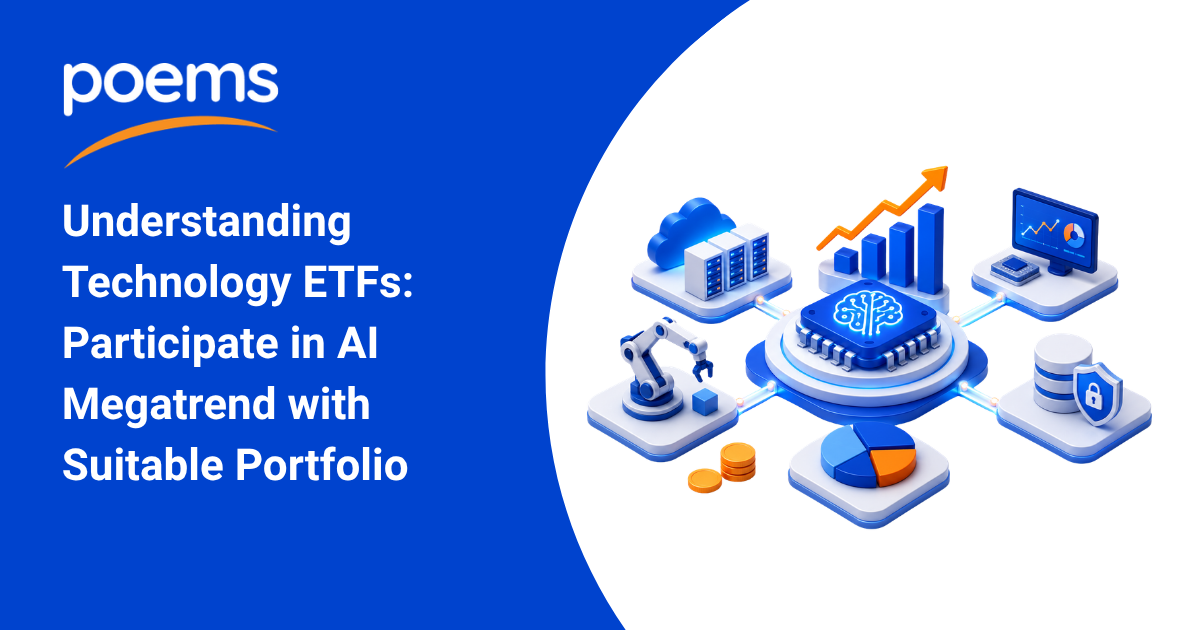
Understanding Technology ETFs: Participate in AI Megatrend with Suitable Portfolio
When constructing an investment portfolio, defensive assets such as bonds and income-generating equities provide stability. However, to outperform inflation and achieve meaningful long-term wealth compounding, investors may benefit from allocating more into growth companies. In today’s global economy, one of the key growth engines is the technology sector, which powers the artificial intelligence (AI) ecosystem. From semiconductors and cloud infrastructure to data centres and advanced software, AI is not a single industry—it is an entire value chain. For retail investors, Technology ETFs (Exchange-Traded Funds) offer the most efficient way to gain diversified exposure across this ecosystem without the concentration risk of picking individual winners. This guide focuses on how investors can strategically deploy different types of Technology ETFs to capture the AI megatrend. 1. Understanding Tech ETFs as AI Exposure Vehicles Technology ETFs are fundamentally growth-oriented instruments with higher investment risk profiles compared to broad-based market ETFs. Unlike traditional value sectors, technology companies reinvest earnings into innovation, allowing them to scale rapidly alongside structural trends such as AI adoption. Key implications for investors: Higher Volatility, Higher Potential Returns: Tech ETFs may enjoy large upside growth, but they can also suffer from sharper drawdowns across market cycles. Interest Rate Sensitivity: Falling rates tend to support technology valuations, making macro timing relevant for entry points. Capital Gains Focus: Returns are driven primarily by price appreciation, not dividends. For investors, this means Tech ETFs should be positioned as long-term growth allocators, not income tools. 2. Mapping Tech ETFs to the AI Value Chain A more effective way to invest in AI is to understand where each ETF sits within the AI infrastructure stack: AI Value Chain Exposure via ETFs: AI Models & Software (Top Layer) Exposure via mega-cap heavy ETFs, such as NASDAQ-100 trackers → Example of companies: Microsoft, Alphabet, Meta Compute & Data Centres (Middle Layer) Exposure via diversified or semiconductor-focused ETFs → Example of companies: NVIDIA, AMD, Broadcom Infrastructure Enablers (Foundational Layer) Indirect exposure via broader tech or thematic ETFs → Examples include power, cooling, and industrial enablers Investor Insight: Owning a single ETF may overweight one layer. Selecting a few targeted ETFs can help investors expand their exposure across the AI ecosystem. 3. Choosing the Right “Flavour” of Tech ETF (With Real Market Proxies) To effectively capture the AI megatrend, investors should think beyond generic “tech exposure” and instead select ETFs based on where they sit within the AI ecosystem and their risk-return profile. Below is a practical breakdown using widely traded institutional ETFs: ETF Name Ticker Listing Strategy AUM (Approx) Expense Ratio No. of Holdings Key Exposure Invesco QQQ Trust QQQ NASDAQ Mega-cap growth ~US$494B 0.18% ~102 AI platforms (Microsoft, NVIDIA, Apple) Technology Select Sector SPDR XLK NYSE Arca S&P 500 Tech ~US$124B 0.08% ~75 Pure US tech leaders Invesco NASDAQ Next Gen 100 QQQJ NASDAQ Mid-cap innovators ~US$1B 0.15% ~104 Emerging AI & software players iShares MSCI World IT UCITS ETF WITS Euronext Global diversified ~US$1.04B 0.18% ~135 Global tech (US and Europe e.g. ASML) iShares Hang Seng TECH ETF 3067 HK HKEX China tech ~HKD15B 0.25% ~34 Alibaba, Tencent, Meituan a) Mega-Cap Tech ETFs (Core AI Exposure): A significant portion of AI profits today is concentrated within a handful of mega-cap firms. These ETFs are the most direct way to gain exposure to AI leaders and hyperscalers, which dominate spending on AI infrastructure and model development. Examples: QQQ - Invesco QQQ Trust, XLK - State Street Technology Select Sector SPDR ETF b) Small & Mid-Cap Tech ETFs (AI Growth Optionality): While riskier, these companies represent more specific firms benefiting from AI growth These ETFs target the next generation of AI beneficiaries, including: SaaS platforms integrating AI Cybersecurity firms Vertical AI applications Example: QQQJ - Invesco NASDAQ Next Gen 100 ETF c) Multi-Cap / Global Tech ETFs (Balanced Exposure): AI sector involves global supply chain. Global exposure helps investors avoid missing out on the growth of critical enablers outside of US market Example: WITS - iShares MSCI World Information Technology Sector Advanced UCITS ETF USD Inc These ETFs provide diversified exposure across: US mega-cap leaders Semiconductor supply chain International tech, such as ASML in Europe d) Regional Tech ETFs (China / Asia Angle): Asia and other regions also have significant investment opportunities tapping on the AI technology growth These ETFs capture: China’s AI ecosystem Platform companies adapting AI into e-commerce, fintech, and logistics Key risk: Regulatory intervention and policy shifts remain a key overhang. Example: 3067 HK - iShares Hang Seng TECH ETF 4. Implementation Strategy: Building an AI ETF Portfolio Rather than selecting a single ETF, investors should construct a layered exposure strategy aligned with the AI value chain. Step 1: Define Your Core Exposure (Foundation Layer) Start with a mega-cap ETF (QQQ or XLK) Suggested allocation: 15%–25% Step 2: Add Diversification (Ecosystem Layer) Incorporate a global or multi-cap ETF (WITS) Suggested allocation: 10%–20% Step 3: Add Growth Optionality (Satellite Layer) Allocate to mid-cap innovators (QQQJ) Suggested allocation: 5%–10% Step 4: Optional Regional Tilt (Tactical Layer) For investors seeking diversification Suggested allocation: 0%–10% Example Portfolio Construction (Balanced Investor) Allocation Bucket ETF Example Weight Core AI Leaders QQQ 20% Global Tech Diversification WITS 15% Growth Innovators QQQJ 10% Asia Tech Exposure 3067 HK 5% Total Tech Allocation 50% The AI opportunity is not confined to a single company or ETF. It is a multi-layer ecosystem spanning platforms, compute, and infrastructure. By combining different types of Technology ETFs, investors can: Capture exposure to current AI leaders Participate in future disruptors Gain exposure to the global technology supply chain The AI megatrend acts as a structural growth multiplier due to the following growth factors: Rising global AI capital expenditure Increasing demand for compute and infrastructure Productivity gains across industries Even a modest allocation can potentially enhance long-term portfolio returns. 6. Implementation Checklist for Investors Before investing in any Technology ETF, investors can apply this screening framework: Concentration Risk Check the ETF’s top holdings andensure alignment with your investment conviction Sub-sector Exposure Know whether you are buying exposure to semiconductors, software, or broad technology Expense Ratio For passive ETFs, consider funds with an expense ratio below 0.50% Liquidity & AUM Prefer funds with strong trading volume and scale and sufficient scale Currency Considerations Factor in USD/HKD currency risk exposure against SGD base currency Final Takeaway The AI revolution is not just about breakthrough technologies—it is also about the infrastructure and ecosystem that supports it. Technology ETFs provide investors with a scalable, diversified, and liquid way to participate in this transformation. If bonds are the anchor of a portfolio, then Technology ETFs can serve as the growth engine—capturing the momentum of AI, compounding capital over time, and positioning investors on the right side of one of the most powerful structural trends of this decade. Disclaimer These commentaries are intended for general circulation and do not have regard to the specific investment objectives, financial situation and particular needs of any person. Accordingly, no warranty whatsoever is given and no liability whatsoever is accepted for any loss arising whether directly or indirectly as a result of any person acting based on this information. You should seek advice from a financial adviser regarding the suitability of any investment product(s) mentioned herein, taking into account your specific investment objectives, financial situation or particular needs, before making a commitment to invest in such products. Opinions expressed in these commentaries are subject to change without notice. Investments are subject to investment risks including the possible loss of the principal amount invested. The value of units in any fund and the income from them may fall as well as rise. Past performance figures as well as any projection or forecast used in these commentaries are not necessarily indicative of future or likely performance. Phillip Securities Pte Ltd (PSPL), its directors, connected persons or employees may from time to time have an interest in the financial instruments mentioned in these commentaries. The information contained in these commentaries has been obtained from public sources which PSPL has no reason to believe are unreliable and any analysis, forecasts, projections, expectations and opinions (collectively the “Research”) contained in these commentaries are based on such information and are expressions of belief only. PSPL has not verified this information and no representation or warranty, express or implied, is made that such information or Research is accurate, complete or verified or should be relied upon as such. Any such information or Research contained in these commentaries are subject to change, and PSPL shall not have any responsibility to maintain the information or Research made available or to supply any corrections, updates or releases in connection therewith. In no event will PSPL be liable for any special, indirect, incidental or consequential damages which may be incurred from the use of the information or Research made available, even if it has been advised of the possibility of such damages. The companies and their employees mentioned in these commentaries cannot be held liable for any errors, inaccuracies and/or omissions howsoever caused. Any opinion or advice herein is made on a general basis and is subject to change without notice. The information provided in these commentaries may contain optimistic statements regarding future events or future financial performance of countries, markets or companies. You must make your own financial assessment of the relevance, accuracy and adequacy of the information provided in these commentaries. Views and any strategies described in these commentaries may not be suitable for all investors. Opinions expressed herein may differ from the opinions expressed by other units of PSPL or its connected persons and associates. Any reference to or discussion of investment products or commodities in these commentaries is purely for illustrative purposes only and must not be construed as a recommendation, an offer or solicitation for the subscription, purchase or sale of the investment products or commodities mentioned. This advertisement has not been reviewed by the Monetary Authority of Singapore.