DSPP
A direct stock purchase plan (DSPP) offers a straightforward way to buy shares directly, and this plan is ideal for investors who wish to invest small amounts regularly. It enables investors to acquire shares slowly with a minimal investment.
Since no broker exists, this plan is simpler and often less expensive. Automatic purchasing and dividend reinvestment make it easy to develop an investor’s stock using DSPPs gently, and investors may safely spend more money over time using this strategy.
Table of Contents
What is a direct stock purchase plan?
A direct stock purchase plan (DSP) is a program that allows investors to buy shares of a company directly from the company without needing a broker. By using a DSP instead of broker fees, investors may save money, which simplifies investing and encourages more investors to do so.
Companies usually require a small initial investment to attract new investors, and the initial investment might be the same magnitude or considerably more significant. Some schemes let investors acquire shares at a discount, and another perk is that companies may benefit from DSPPs in safeguarding investors’ rights and producing money.
Understanding direct stock purchase plan
Investors must understand that a direct stock purchase plan (DSPP) permits purchasers to acquire shares directly from companies at predetermined periods, generally once a month or three times a year.
Companies usually handle these initiatives themselves or via a third-party transfer provider, and investors get full disclosure of their stock purchases and profits. With this much transparency, investors can better monitor their assets and investor performance.
Saving profits is a unique feature of specific dividend-paying programs (DSPP). Instead of receiving cash incentives, diversified investors might acquire additional firm shares with their returns, and dividend reinvestment increases asset value without increasing investment.
Advantages of direct stock purchase plan
- Cost savings
Investors using direct stock purchase plans pay no broker fees, which allows investors to invest without broker costs. This program may save investors’ money because they have little or no transaction costs without broker fees. Investor’s money will purchase shares directly, which is useful for frequent investors since they may accumulate shares without paying more.
- Lower initial investment
DSPPs often require a low initial investment, sometimes as little as low or high. This low entry point allows low-income investors to enter the market. One of its most extensive features is that new investors, like students or young professionals, begin building their investment portfolios early. DSPPs allow consumers to invest tiny sums in the stock market and progressively create wealth.
- Automatic investments
These programs give investors the convenience of automatic investments, which makes investing simple and stress-free. Investors benefit from automated purchasing, which enables them to acquire shares monthly or quarterly, and scheduled investments let stocks expand slowly and promote caution.
- Dividend reinvestment
Many DSPPs allow investors to reinvest dividends to purchase additional shares. Investors might receive dividends in cash or acquire additional company shares, and this feature lets investors expand their holdings without investing more. Reinvesting revenue in companies may boost profits, and the payments increase earnings, which helps investors’ investment stock expand over time.
- Discounted share prices
Discounted share prices Some companies offer discounted shares through their DSPPs, meaning investors can buy shares below the current market price. Investors may earn money quickly by taking advantage of this price decline, which makes the company more enticing to the owner. Buying shares at a lower price may boost the interest rate because share prices are more likely to rise.
Impact on company and shareholders
- Increased capital for the company
Investors who acquire shares directly from the company frequently feel more invested in the company’s success. Investors who own the company may care more about and support its operations. Loyal investors support long-term business objectives, vote on management strategies, and participate in corporate activities.
- Enhanced shareholder loyalty
Companies may increase shares by attracting a broad spectrum of purchasers using DSPPs, and investors may have yet to invest in them due to extremely high trading costs or massive initial investment demands. Investors may expand their shareholder base by lowering barriers to entry, and many investors will boost the company’s market position and appeal to investors and purchasers.
- Stabilised stock prices
Direct stock purchase plan (DSPP) companies may be more consistent with stock prices. If many investors invest small amounts, the unstable market may be affected less. Investors buying shares consistently can keep the stock price from fluctuating too much during significant transactions.
- Improved investor relations
Companies must communicate with investors honestly and openly to manage a DSPP. Strong investor ties help investors trust a company’s management and plan more. By communicating openly and providing helpful information, a company may enhance its image and strengthen connections with existing and future investors.
Examples of direct stock purchase plan
Coca-Cola offers one notable example of a direct stock purchase plan (DSPP). Coca-Cola’s DSPP enables investors to acquire shares directly from the corporation without a broker. Let’s say an investor invests US$50 and makes US$50 monthly payments.
If one Coca-Cola stock costs US$50, an investor may invest US$50 in the company each month and acquire additional shares in the coming months. To simplify matters, let’s assume the stock price remains US$50 until further notice.
After one year, the investor has invested US$600 (US$50 initial investment + US$50 per month for 11 months). A US$50 stock investor expected it to remain, which would have acquired 12 US$600 shares if it were true.
Direct stock purchase plan investment plan shares might be discounted by 3% by Coca-Cola, and the investor would benefit from buying shares at US$48.50 each (97% of US$50).
Frequently Asked Questions
Direct stock purchase plans allow investors to acquire shares directly from a company. After making the initial purchase, investors may acquire additional shares monthly or quarterly, and the payment options include mailing a cheque or setting up bank account transfers. This method allows consistent investing and stock purchases. Investors are always informed of their stocks and actions throughout management.
DSPP investors don’t pay broker fees, among other stocks, which reduces purchase expenses. Investors and buyers usually acquire shares at a price to increase their investments. Since DSPPs automatically spend investor’s money, which may make recurring payments without doing anything. DSPPs often reinvest dividends to acquire new shares, increasing ownership over time, which allows investors to establish an extensive portfolio.
Participating in a DSPP offers several benefits, including eliminating broker commissions, which reduces investment costs. Even with these charges, DSPP investors pay less than regular investors, which is true even though these expenses are usually included. Investor’s expenses are applied to each share transaction, while enrollment fees cover setup costs. Most investors assume they’re minor compared to the money saved by not paying broker fees because there are no broker costs.
DSPPs eliminate broker commissions, and they may involve some fees, including enrolment fees, purchase fees, and fees for selling shares. Small fees may apply to selling shares, but the procedure is typically simple, and the money from selling the shares may be put into your bank account or paid to you in cash. Investors may access their funds anytime they need to while benefiting from DSPPs.
DSPPs are fantastic for long-term investments as these small, consistent contributions allow investors to increase their holdings progressively. This approach enables a dollar-cost average, which maintains spending over time, and profits may be reinvested to promote stock growth via compounding. Investing in additional shares over time may make assets more valuable because defined contribution pension plans (DSPPs) are ideal for persons who wish to invest carefully.
Related Terms
- Compound Yield
- Discretionary Accounts
- Industry Groups
- Growth Rate
- Foreign Direct Investment (FDI)
- Floating Dividend Rate
- Real Return
- Non-Diversifiable Risk
- Liability-Driven Investment (LDI)
- Guaranteed Investment Contract (GIC)
- Flash Crash
- Cost Basis
- Deferred Annuity
- Cash-on-Cash Return
- Bubble
- Compound Yield
- Discretionary Accounts
- Industry Groups
- Growth Rate
- Foreign Direct Investment (FDI)
- Floating Dividend Rate
- Real Return
- Non-Diversifiable Risk
- Liability-Driven Investment (LDI)
- Guaranteed Investment Contract (GIC)
- Flash Crash
- Cost Basis
- Deferred Annuity
- Cash-on-Cash Return
- Bubble
- Asset Play
- Accrued Market Discount
- Inflation Hedge
- Incremental Yield
- Holding Period Return
- Hedge Effectiveness
- Fallen Angel
- EBITDA Margin
- Dollar Rolls
- Dividend Declaration Date
- Distribution Yield
- Derivative Security
- Fiduciary
- Current Yield
- Core Position
- Cash Dividend
- Broken Date
- Share Classes
- Valuation Point
- Breadth Thrust Indicator
- Book-Entry Security
- Bearish Engulfing
- Core inflation
- Approvеd Invеstmеnts
- Allotment
- Annual Earnings Growth
- Solvency
- Impersonators
- Reinvestment date
- Volatile Market
- Trustee
- Sum-of-the-Parts Valuation (SOTP)
- Proxy Voting
- Passive Income
- Diversifying Portfolio
- Open-ended scheme
- Capital Gains Distribution
- Investment Insights
- Discounted Cash Flow (DCF)
- Portfolio manager
- Net assets
- Nominal Return
- Systematic Investment Plan
- Issuer Risk
- Fundamental Analysis
- Account Equity
- Withdrawal
- Realised Profit/Loss
- Unrealised Profit/Loss
- Negotiable Certificates of Deposit
- High-Quality Securities
- Shareholder Yield
- Conversion Privilege
- Cash Reserve
- Factor Investing
- Open-Ended Investment Company
- Front-End Load
- Tracking Error
- Replication
- Real Yield
- Bought Deal
- Bulletin Board System
- Portfolio turnover rate
- Reinvestment privilege
- Initial purchase
- Subsequent Purchase
- Fund Manager
- Target Price
- Top Holdings
- Liquidation
- Direct market access
- Deficit interest
- EPS forecast
- Adjusted distributed income
- International securities exchanges
- Margin Requirement
- Pledged Asset
- Stochastic Oscillator
- Prepayment risk
- Homemade leverage
- Prime bank investments
- ESG
- Capitulation
- Shareholder service fees
- Insurable Interest
- Minority Interest
- Passive Investing
- Market cycle
- Progressive tax
- Correlation
- NFT
- Carbon credits
- Hyperinflation
- Hostile takeover
- Travel insurance
- Money market
- Dividend investing
- Digital Assets
- Coupon yield
- Counterparty
- Sharpe ratio
- Alpha and beta
- Investment advisory
- Wealth management
- Variable annuity
- Asset management
- Value of Land
- Investment Policy
- Investment Horizon
- Forward Contracts
- Equity Hedging
- Encumbrance
- Money Market Instruments
- Share Market
- Opening price
- Transfer of Shares
- Alternative investments
- Lumpsum
- Derivatives market
- Operating assets
- Hypothecation
- Accumulated dividend
- Assets under management
- Endowment
- Return on investment
- Investments
- Acceleration clause
- Heat maps
- Lock-in period
- Tranches
- Stock Keeping Unit
- Real Estate Investment Trusts
- Prospectus
- Turnover
- Tangible assets
- Preference Shares
- Open-ended investment company
- Ordinary Shares
- Leverage
- Standard deviation
- Independent financial adviser
- ESG investing
- Earnest Money
- Primary market
- Leveraged Loan
- Transferring assets
- Shares
- Fixed annuity
- Underlying asset
- Quick asset
- Portfolio
- Mutual fund
- Xenocurrency
- Bitcoin Mining
- Option contract
- Depreciation
- Inflation
- Cryptocurrency
- Options
- Fixed income
- Asset
- Reinvestment option
- Capital appreciation
- Style Box
- Top-down Investing
- Trail commission
- Unit holder
- Yield curve
- Rebalancing
- Vesting
- Private equity
- Bull Market
- Absolute Return
- Leaseback
- Impact investing
- Venture Capital
- Buy limit
- Asset stripper
- Volatility
- Investment objective
- Annuity
- Sustainable investing
- Face-amount certificate
- Lipper ratings
- Investment stewardship
- Average accounting return
- Asset class
- Active management
- Breakpoint
- Expense ratio
- Bear market
- Hedging
- Equity options
- Dollar-Cost Averaging (DCA)
- Due Diligence
- Contrarian Investor
Most Popular Terms
Other Terms
- Bond Convexity
- Brokerage Account
- Green Bond Principles
- Gamma Scalping
- Funding Ratio
- Free-Float Methodology
- Flight to Quality
- Protective Put
- Perpetual Bond
- Option Adjusted Spread (OAS)
- Merger Arbitrage
- Income Bonds
- Equity Carve-Outs
- Cost of Equity
- Earning Surprise
- Capital Adequacy Ratio (CAR)
- Beta Risk
- Bear Spread
- Ladder Strategy
- Junk Status
- Intrinsic Value of Stock
- Interest-Only Bonds (IO)
- Interest Coverage Ratio
- Industry Groups
- Industrial Bonds
- Income Statement
- Historical Volatility (HV)
- Flat Yield Curve
- Exotic Options
- Execution Risk
- Exchange-Traded Notes
- Event-Driven Strategy
- Eurodollar Bonds
- Enhanced Index Fund
- Embedded Options
- Dynamic Asset Allocation
- Dual-Currency Bond
- Downside Capture Ratio
- Dividend Capture Strategy
- Depositary Receipts
- Delta Neutral
- Deferment Payment Option
- Dark Pools
- Death Cross
- Debt-to-Equity Ratio
- Fixed-to-floating rate bonds
- First Call Date
- Financial Futures
- Firm Order
- Credit Default Swap (CDS)
Know More about
Tools/Educational Resources
Markets Offered by POEMS
Read the Latest Market Journal
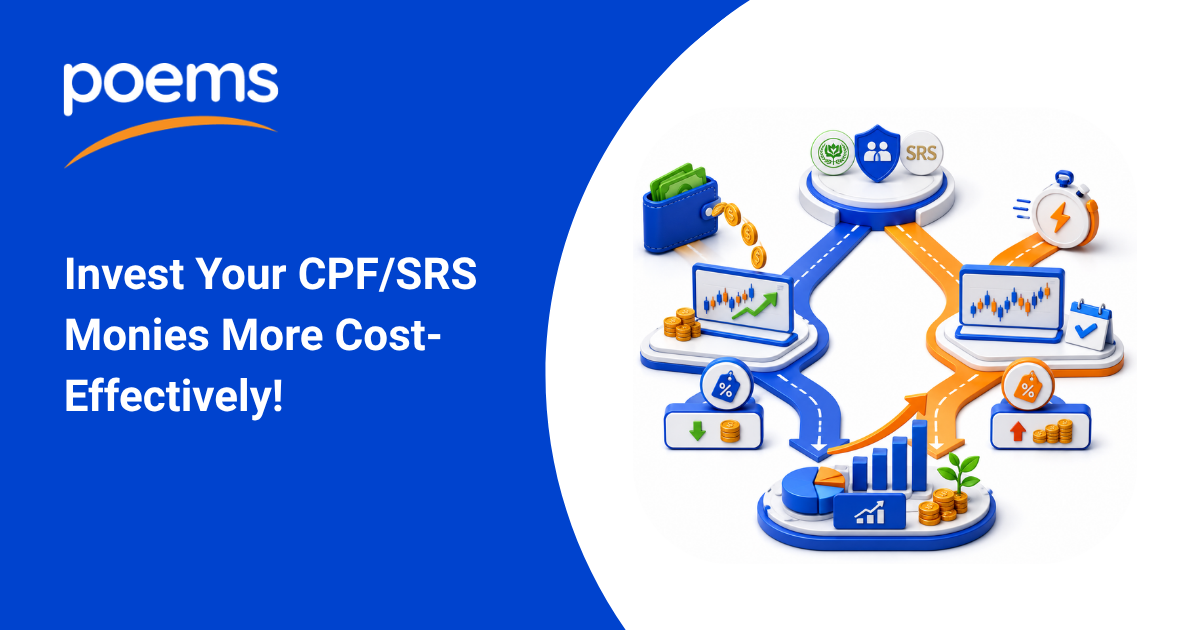
Save on Brokerage Fees When Trading with CPF/SRS Funds
If you want to invest using your CPF Investment Account (CPFIS) or Supplementary Retirement Scheme (SRS) funds, you can choose between our Cash Plus Account and Cash Management Account. Both account types allow you to trade using your CPF/SRS monies. Read on to find out how they differ! Cash Plus Account Cash Plus Account offers a significantly lower brokerage rate of 0.08% with no minimum commission for trading on the SGX market. To place a BUY order, you will need to prefund your account with cash. A minimum of 50% of the expected trade value* is required as buying power before a trade can be placed or submitted online. The good news is that cash is only required temporarily. Once the CPF/SRS trade is settled, the prefunded amount can be withdrawn or used for the next trade. This could potentially result in significant cost savings for smaller trades and Dollar Cost Averaging (DCA) strategy! *Full amount is required for non-marginable counters Cash Management Account Cash Management Account offers greater convenience as no prefunding is required. We will increase your trading limit after reviewing your CPF/SRS statements. This allows you to place trades directly using the approved trading limit. However, the brokerage fee is higher at 0.28%, subject to a minimum commission of S$25. Example: BUY 100 shares of DBS at S$64.38 per share Trade Value: S$6,438 Under Cash Management Account: Approx. Brokerage Fee: S$25 (Minimum commission applies) Under Cash Plus Account: Approx. Brokerage Fee: S$5.20 By prefunding the required amount on Cash Plus Account, you could save approximately SGD 20 on brokerage fees for this trade alone. Which account should you choose? If you are comfortable prefunding your account with cash, the Cash Plus Account can help you reduce trading costs substantially. The prefunded cash can be withdrawn after the CPF/SRS transaction has been settled. If you prefer the convenience of trading without prefunding, Cash Management Account may be more suitable, although the brokerage charges will be higher. For investors looking to minimize trading costs, the Cash Plus Account is generally the more cost-effective option. Disclaimer These commentaries are intended for general circulation and do not have regard to the specific investment objectives, financial situation and particular needs of any person. Accordingly, no warranty whatsoever is given and no liability whatsoever is accepted for any loss arising whether directly or indirectly as a result of any person acting based on this information. You should seek advice from a financial adviser regarding the suitability of any investment product(s) mentioned herein, taking into account your specific investment objectives, financial situation or particular needs, before making a commitment to invest in such products. Opinions expressed in these commentaries are subject to change without notice. Investments are subject to investment risks including the possible loss of the principal amount invested. The value of units in any fund and the income from them may fall as well as rise. Past performance figures as well as any projection or forecast used in these commentaries are not necessarily indicative of future or likely performance. Phillip Securities Pte Ltd (PSPL), its directors, connected persons or employees may from time to time have an interest in the financial instruments mentioned in these commentaries. The information contained in these commentaries has been obtained from public sources which PSPL has no reason to believe are unreliable and any analysis, forecasts, projections, expectations and opinions (collectively the “Research”) contained in these commentaries are based on such information and are expressions of belief only. PSPL has not verified this information and no representation or warranty, express or implied, is made that such information or Research is accurate, complete or verified or should be relied upon as such. Any such information or Research contained in these commentaries are subject to change, and PSPL shall not have any responsibility to maintain the information or Research made available or to supply any corrections, updates or releases in connection therewith. In no event will PSPL be liable for any special, indirect, incidental or consequential damages which may be incurred from the use of the information or Research made available, even if it has been advised of the possibility of such damages. The companies and their employees mentioned in these commentaries cannot be held liable for any errors, inaccuracies and/or omissions howsoever caused. Any opinion or advice herein is made on a general basis and is subject to change without notice. The information provided in these commentaries may contain optimistic statements regarding future events or future financial performance of countries, markets or companies. You must make your own financial assessment of the relevance, accuracy and adequacy of the information provided in these commentaries. Views and any strategies described in these commentaries may not be suitable for all investors. Opinions expressed herein may differ from the opinions expressed by other units of PSPL or its connected persons and associates. Any reference to or discussion of investment products or commodities in these commentaries is purely for illustrative purposes only and must not be construed as a recommendation, an offer or solicitation for the subscription, purchase or sale of the investment products or commodities mentioned. This advertisement has not been reviewed by the Monetary Authority of Singapore.

The True Zero: More Than Just Savings
What Would You Do With Zero? The best time to start investing was yesterday. The second-best time is today. Now, with our US$0 commission trading on POEMS, investors can focus more on opportunities and less on transaction costs. For many first-time investors, the hesitation is not a lack of interest. Instead, it is the thought of paying a commission on every trade, especially when the investment amount is small. This creates a false impression that investing only makes sense when there is a larger pool of capital. The absence of commission fees changes this dynamic. When commission fees are removed, getting started on investing becomes easier. Investors have one less reason to hesitate and can begin with the amount they are comfortable with, invest consistently over time, and respond to market opportunities without having to factor trading costs into every decision. Freedom To Start Small Many people think investing is something you do once you have accumulated enough capital. But waiting for "enough" is often what prevents people from investing in the first place. Successful investing is not about starting with a large amount. It is more about starting early and staying consistent. Consider investing just US$100 a month. Over 20 years, the amount accumulated may surprise you. Not because US$100 is a large sum, but because time, consistency, and compounding work together to build wealth over the long term. To illustrate, the table below uses a 7% annual return, based on the S&P 500's long-term historical average, alongside a typical savings account interest rate of 1.8% p.a. While past performance does not guarantee future results, it serves as a useful benchmark to demonstrate the potential impact of long-term investing. Year Total Contribution (US$) Invested (7% p.a.) (US$) Saving Account (1.8% p.a.) (US$) 1 1,200 1,239 1,210 5 6,000 7,159 6,273 10 12,000 17,308 13,137 15 18,000 31,696 20,647 20 24,000 52,093 28,863 Actual returns will vary and are not guaranteed. Investing involves risk, including the possible loss of principal. With US$0 commission on POEMS, investors can put smaller amounts to work without having to consider whether trading costs outweigh the value of their investment. Whether you are investing $50 or $500, the ability to start small makes it easier to build disciplined investing habits over time. Time in the market can have a greater impact on long-term outcomes than the size of the initial investment. The key is not how much you start with, but having the confidence to take the first step. Freedom To Turn Headlines Into Investments Every day, investors are exposed to headlines on artificial intelligence breakthroughs, technology IPOs, cybersecurity advances, semiconductor developments, and the growing space technology. These stories are hard to ignore and naturally prompt investors to take action. Thematic ETFs help by offering targeted exposure to sectors and industries shaped by long-term structural trends. Instead of researching and selecting individual companies, investors can gain diversified exposure through a single investment. Whether it is artificial intelligence, semiconductors, or space technology, thematic ETFs allow investors to translate ideas sparked by headlines into actionable opportunities. In the past, acting on such ideas often came with a hidden cost. Commission fees made smaller, exploratory investments harder to justify, causing many investors to stay on the sidelines while trends unfolded. With US$0 commission, investors can now explore emerging themes without the barrier of transaction costs. This allows for smaller positions, gradual conviction-building, and more flexible portfolio construction over time. After all, ideas are only as valuable as the ability to act on them. Freedom To Stay Consistent Successful investors often have one thing in common: consistency. Instead of chasing market highs and lows, they invest regularly through monthly contributions, dollar-cost averaging, and long-term portfolio building. These habits compound over time, but they are most effective when investors maintain them consistently. Historically, commission fees created friction by adding a cost to every transaction, discouraging frequent, smaller investments. With US$0 commission, that obstacle is removed, and makes it easier for investors to commit to regular contributions, stay the course through market volatility, and build their portfolios steadily without eroding returns at the point of entry. Consistency beats complexity. When the cost to stay consistent is zero, it becomes easier to invest for the long term. Freedom To Own The Future: Understanding Your Financial Needs Everyone’s investment journey is different. Investing carries risk, and understanding your own financial situation is the first step to navigating it well. Factors such as risk tolerance, your investment horizon, and investment objective should shape the decisions you make along the way. The US$0 commission removes one variable from that equation, meaning your decisions can be driven by opportunity and strategy, rather than transaction costs. Now, investors can start small, act on ideas and stay consistent with greater flexibility. With US$0 commission on POEMS Cash Plus, accessing these opportunities becomes more convenient and cost-efficient. Whether you are just starting or building on an existing portfolio, now may be a good time to take the next step. Invest in US stocks with zero commission through POEMS Cash Plus here. All investments carry risk. Please ensure you understand your own financial situation and risk tolerance before investing. References: 1. https://www.sofi.com/learn/content/average-stock-market-return/ Disclaimer These commentaries are intended for general circulation and do not have regard to the specific investment objectives, financial situation and particular needs of any person. Accordingly, no warranty whatsoever is given and no liability whatsoever is accepted for any loss arising whether directly or indirectly as a result of any person acting based on this information. You should seek advice from a financial adviser regarding the suitability of any investment product(s) mentioned herein, taking into account your specific investment objectives, financial situation or particular needs, before making a commitment to invest in such products. Opinions expressed in these commentaries are subject to change without notice. Investments are subject to investment risks including the possible loss of the principal amount invested. The value of units in any fund and the income from them may fall as well as rise. Past performance figures as well as any projection or forecast used in these commentaries are not necessarily indicative of future or likely performance. Phillip Securities Pte Ltd (PSPL), its directors, connected persons or employees may from time to time have an interest in the financial instruments mentioned in these commentaries. The information contained in these commentaries has been obtained from public sources which PSPL has no reason to believe are unreliable and any analysis, forecasts, projections, expectations and opinions (collectively the “Research”) contained in these commentaries are based on such information and are expressions of belief only. PSPL has not verified this information and no representation or warranty, express or implied, is made that such information or Research is accurate, complete or verified or should be relied upon as such. Any such information or Research contained in these commentaries are subject to change, and PSPL shall not have any responsibility to maintain the information or Research made available or to supply any corrections, updates or releases in connection therewith. In no event will PSPL be liable for any special, indirect, incidental or consequential damages which may be incurred from the use of the information or Research made available, even if it has been advised of the possibility of such damages. The companies and their employees mentioned in these commentaries cannot be held liable for any errors, inaccuracies and/or omissions howsoever caused. Any opinion or advice herein is made on a general basis and is subject to change without notice. The information provided in these commentaries may contain optimistic statements regarding future events or future financial performance of countries, markets or companies. You must make your own financial assessment of the relevance, accuracy and adequacy of the information provided in these commentaries. Views and any strategies described in these commentaries may not be suitable for all investors. Opinions expressed herein may differ from the opinions expressed by other units of PSPL or its connected persons and associates. Any reference to or discussion of investment products or commodities in these commentaries is purely for illustrative purposes only and must not be construed as a recommendation, an offer or solicitation for the subscription, purchase or sale of the investment products or commodities mentioned. This advertisement has not been reviewed by the Monetary Authority of Singapore.
Market Performance and Outlook Singapore REITs faced headwinds in May 2026, with the S-REITs Index declining 1.6% as markets increasingly priced in potential interest rate hikes, reversing the previous month's 3.2% gain. Despite this setback, Phillip Securities Research maintains its OVERWEIGHT stance on the sector, while adopting a selective approach given the current interest rate environment. The performance disparity within the sector was notable. AIMS APAC REIT led gains at 4.6% following strong FY26 results, while Acrophyte Hospitality Trust suffered a significant 20% decline due to severe weather conditions and rising operating costs affecting its 1Q26 performance. Sector-wise, overseas retail emerged as the best-performing sub-sector with a 0.3% gain, whilst overseas commercial lagged with a 3.5% decline as US-office REITs reacted negatively to higher interest rate prospects. Interest Rate Environment and Growth Expectations The global monetary policy landscape remains mixed, with the ECB and BOJ raising policy rates by 25 basis points in June, whilst the Fed maintained rates unchanged at 3.50% to 3.75%. However, the Fed's dot plot indicates potential for one rate hike in 2026, with markets pricing in two rate hikes by year-end. Despite these concerns, Phillip Securities expects approximately 80% of S-REITs to benefit from stable or lower financing costs, as benchmark interest rates remain lower year-on-year. The 3M SORA has declined over 110 basis points year-on-year to approximately 1.08%, providing tailwinds for Singapore REITs with SGD-denominated debt due for refinancing. This favourable environment, combined with rental growth of 1% to 3% from contractual escalations and positive reversions, should support average DPU growth of approximately 3% year-on-year for covered S-REITs in FY26e. Investment Strategy and Top Picks Phillip Securities' investment preference centres on REITs with robust balance sheets, defensive earnings profiles, and higher proportions of fixed-rate borrowings. The firm particularly favours retail S-REITs, supported by healthy tenant sales and limited new supply, which should underpin mid- to high-single-digit rental reversions in 2026. The research house's top picks include Stoneweg Europe Stapled Trust (BUY, target price: €1.89), Elite UK REIT (BUY, target price: £0.41), United Hampshire US REIT (BUY, target price: US$0.69), and Prime US REIT (BUY, target price: US$0.32). Stoneweg Europe Stapled Trust stands out with 87% of debt hedged through late 2027 and FY26e cost of debt to remain below 4% despite recent ECB rate hikes.It is also trading at a 25% discount to NAV, with an attractive 8.6% dividend yield. Frequently Asked Questions [market_journal_faq] This article has been auto-generated using PhillipGPT. It is based on a report by a Phillip Securities Research analyst. Disclaimer These commentaries are intended for general circulation and do not have regard to the specific investment objectives, financial situation and particular needs of any person. Accordingly, no warranty whatsoever is given and no liability whatsoever is accepted for any loss arising whether directly or indirectly as a result of any person acting based on this information. You should seek advice from a financial adviser regarding the suitability of any investment product(s) mentioned herein, taking into account your specific investment objectives, financial situation or particular needs, before making a commitment to invest in such products. Opinions expressed in these commentaries are subject to change without notice. Investments are subject to investment risks including the possible loss of the principal amount invested. The value of units in any fund and the income from them may fall as well as rise. Past performance figures as well as any projection or forecast used in these commentaries are not necessarily indicative of future or likely performance. Phillip Securities Pte Ltd (PSPL), its directors, connected persons or employees may from time to time have an interest in the financial instruments mentioned in these commentaries. The information contained in these commentaries has been obtained from public sources which PSPL has no reason to believe are unreliable and any analysis, forecasts, projections, expectations and opinions (collectively the “Research”) contained in these commentaries are based on such information and are expressions of belief only. PSPL has not verified this information and no representation or warranty, express or implied, is made that such information or Research is accurate, complete or verified or should be relied upon as such. Any such information or Research contained in these commentaries are subject to change, and PSPL shall not have any responsibility to maintain the information or Research made available or to supply any corrections, updates or releases in connection therewith. In no event will PSPL be liable for any special, indirect, incidental or consequential damages which may be incurred from the use of the information or Research made available, even if it has been advised of the possibility of such damages. The companies and their employees mentioned in these commentaries cannot be held liable for any errors, inaccuracies and/or omissions howsoever caused. Any opinion or advice herein is made on a general basis and is subject to change without notice. The information provided in these commentaries may contain optimistic statements regarding future events or future financial performance of countries, markets or companies. You must make your own financial assessment of the relevance, accuracy and adequacy of the information provided in these commentaries. Views and any strategies described in these commentaries may not be suitable for all investors. Opinions expressed herein may differ from the opinions expressed by other units of PSPL or its connected persons and associates. Any reference to or discussion of investment products or commodities in these commentaries is purely for illustrative purposes only and must not be construed as a recommendation, an offer or solicitation for the subscription, purchase or sale of the investment products or commodities mentioned. This advertisement has not been reviewed by the Monetary Authority of Singapore.

Unlock Hidden Income in Your Portfolio
Did you know that the shares sitting in your portfolio can generate additional income—without you needing to sell them? Securities lending gives investors the opportunity to earn extra returns on their existing investments by lending their shares to other market participants for a fee. It is a widely used practice in global financial markets and can help you maximise the value of your portfolio. What Is Securities Lending? Securities lending allows you to temporarily lend your shares to borrowers (such as institutional investors or traders) who require them for trading or investment purposes. In return, you receive: Lending income – Earn a fee while your shares are on loan Collateral protection – Your loan is backed by collateral, which is monitored daily Continued market exposure – You still benefit from price movements of your shares This means your portfolio continues to work for you—even when you are not actively trading. Why Do Borrowers Need Your Shares? Borrowing demand comes from various market activities, including: Short selling - When investors expect prices to fall Market making – To provide liquidity in the market Hedging strategies – To manage risk across investment positions These activities are essential to keeping markets efficient and liquid, while creating opportunities for investors like you to earn additional income. Interesting Facts About Securities Lending Not all stocks earn the same lending returns Some stocks are in higher demand and can generate significantly higher fees Demand can fluctuate depending on market trends, news, or corporate events Stocks with limited supply or high short interest are often more valuable to lend In the market, stocks are often classified as: General Collateral (GC) – Commonly available stocks with steady but lower returns “Hot” Stocks (Specials) – Rare or high-demand stocks that can generate premium lending income Opportunity: High-Demand (“Hot”) Stocks At times, certain stocks experience strong borrowing demand due to: Corporate actions, such as mergers or index changes Market speculation or short interest Tight supply in the market When your holdings fall into this category, you may enjoy higher lending income without making any change to your investment strategy. Why Consider Securities Lending? Generate passive income from your existing holdings Enhance overall portfolio yield No need to actively manage trades Benefit from opportunities when demand spikes Getting Started Securities lending can be seamlessly integrated into your account. With your consent, eligible shares can be made available for lending, and any income earned will be credited to your account on a monthly basis. Simply open SBL account on poems.com.sg Alternatively, you may reach out to our team at sbl@phillip.com.sg for a personalised review and guidance on how to maximise your lending opportunities. Disclaimer These commentaries are intended for general circulation and do not have regard to the specific investment objectives, financial situation and particular needs of any person. Accordingly, no warranty whatsoever is given and no liability whatsoever is accepted for any loss arising whether directly or indirectly as a result of any person acting based on this information. You should seek advice from a financial adviser regarding the suitability of any investment product(s) mentioned herein, taking into account your specific investment objectives, financial situation or particular needs, before making a commitment to invest in such products. Opinions expressed in these commentaries are subject to change without notice. Investments are subject to investment risks including the possible loss of the principal amount invested. The value of units in any fund and the income from them may fall as well as rise. Past performance figures as well as any projection or forecast used in these commentaries are not necessarily indicative of future or likely performance. Phillip Securities Pte Ltd (PSPL), its directors, connected persons or employees may from time to time have an interest in the financial instruments mentioned in these commentaries. The information contained in these commentaries has been obtained from public sources which PSPL has no reason to believe are unreliable and any analysis, forecasts, projections, expectations and opinions (collectively the “Research”) contained in these commentaries are based on such information and are expressions of belief only. PSPL has not verified this information and no representation or warranty, express or implied, is made that such information or Research is accurate, complete or verified or should be relied upon as such. Any such information or Research contained in these commentaries are subject to change, and PSPL shall not have any responsibility to maintain the information or Research made available or to supply any corrections, updates or releases in connection therewith. In no event will PSPL be liable for any special, indirect, incidental or consequential damages which may be incurred from the use of the information or Research made available, even if it has been advised of the possibility of such damages. The companies and their employees mentioned in these commentaries cannot be held liable for any errors, inaccuracies and/or omissions howsoever caused. Any opinion or advice herein is made on a general basis and is subject to change without notice. The information provided in these commentaries may contain optimistic statements regarding future events or future financial performance of countries, markets or companies. You must make your own financial assessment of the relevance, accuracy and adequacy of the information provided in these commentaries. Views and any strategies described in these commentaries may not be suitable for all investors. Opinions expressed herein may differ from the opinions expressed by other units of PSPL or its connected persons and associates. Any reference to or discussion of investment products or commodities in these commentaries is purely for illustrative purposes only and must not be construed as a recommendation, an offer or solicitation for the subscription, purchase or sale of the investment products or commodities mentioned. This advertisement has not been reviewed by the Monetary Authority of Singapore.

Buying the Dip: When are Lower Prices an Opportunity and When are They a Trap
“Buying the dip” is a common investing strategy among retail investors. A share price falls, an index pulls back, or a familiar company suddenly appears cheaper than it did just a few weeks earlier, and the instinctive reaction for savvy investors is to view it as an opportunity. Over the long term, equity markets generally reward patient investors who stay invested despite market volatility. In recent years especially, many market pullbacks were followed by relatively swift recoveries, reinforcing the belief that weakness should be bought rather than feared. The danger, however, is that investors may begin treating every decline as though it represents the same opportunity to “buy the dip”. A lower price does not always equate to better value. Sometimes a sell-off reflects short-term nerves, excessive pessimism or a temporary mismatch between price and fundamentals. At other times, it may point to something more serious: weaker earnings expectations, stretched valuations, changing industry dynamics, higher financing costs or a business model under pressure. That distinction sits at the heart of disciplined investing. Instead of simply asking, “is this cheaper than before?”, investors may benefit more by asking, “does this lower price improve the risk-reward of my portfolio?” Not every pullback is created equal A broad market decline is very different from a fall in an individual stock. When a diversified global index falls, long-term investors may benefit from a greater degree of protection because their risk is spread across many companies, sectors and regions. However, when an individual stock, sector fund or thematic ETF falls, investors are effectively making a more concentrated bet on one company, industry or investment theme. This requires a deeper level of analysis. Investors should consider whether the decline is caused by short-term sentiment or a real deterioration in fundamentals, such as weaker earnings, higher debt costs, loss of pricing power or disruption to the business model. For example, if the MSCI World Index falls 10% during a broad market sell-off, a long-term investor knows that this is a diversified investment which should have a good chance of recovery and long-term growth. Compare that to Peloton (NASDAQ: PTON), which is often cited as a value-trap example. After peaking at about US$167.42 on 13 January 2021, the stock continued falling through 2021 and 2022 as demand weakened and profitability deteriorated. The lower price did not automatically represent good value. Instead, it reflected a genuine deterioration in the company’s future prospects. What Makes Today’s Environment Feel Different Today’s environment feels different because of the speed. During the GlobalFinancial Crisis in 2008, markets took many months to hit the bottom. By comparison, during the COVID-19 crisis, markets fell sharply within weeks but also recovered within months, whereas the post-2008 recovery took years. For many investors who remained on the sidelines, the fear of missing out (FOMO) became very real. Investors need to remember that time in the market generally outperforms timing the market because staying invested captures long-term growth and compound returns, whereas trying to predict highs and lows often results in missed opportunities and lower gains. Having said that, investors can still time the market, but they should do so with a plan. For the average investor balancing investing alongside a full-time career, both time in the market and timing the market may have a role to play, but the balance should be calibrated according to individual circumstances and financial objectives. Start with the investor, Not the Market One of the most common mistakes investors make is starting with the price chart. A stock has fallen. A fund is down. A headline says markets are weak. The investor then asks, “should I buy?” A better process begins somewhere else: with the investor’s own circumstances. Before treating lower prices as opportunities, investors should assess three things: their goals, their career stability and their existing assets. First, what is the money intended for? Capital needed for a home upgrade or purchase should be treated differently from long-term retirement capital. A market dip may be attractive, but it becomes far less appealing if the funds are needed in the near term and cannot withstand short-term volatility. Second, how secure is the investor’s income? In an environment where industries and job markets are changing quickly, career risk matters. If income is uncertain, a larger cash buffer may be needed before taking on additional investment risk. Portfolio risk should not be viewed in isolation from career risk. Third, what does the investor already own? Someone already heavily exposed to US technology stocks may increase concentration risk by buying more technology during a pullback. Another investor sitting mostly in cash and fixed deposits may have the opposite problem: being under-invested for long-term goals. This is why the same market opportunity can be suitable for one investor and unsuitable for another. Investing is personal before it is tactical. Where Investors May Be At Risk of Reacting Too Quickly Retail investors are most vulnerable when speed replaces process. One key area of risk involves complex or leveraged investment instruments. Products such as contracts for difference, leveraged ETFs and short-dated options can magnify both gains and losses. They may appear attractive during volatile markets because they offer fast exposure, but they require discipline, risk limits and a clear understanding of how quickly losses can build. For example in 2020, a Robinhood customer saw a negative US$700,000 balance and tragically took his own life after misunderstanding his trading exposure. Another risk is the fear of missing out, or FOMO. Investors may feel compelled to chase a stock simply because others are discussing it, because it performed strongly in the past, or because they fear being left behind. In many cases, FOMO can disguise itself as conviction. For example, on 3 November, 2025, Palantir Technologies reached an intraday high of US$222.05, driven by massive enthusiasm for its AI Platform (AIP) and government contract wins. By January 2026, however, the stock had retraced to approximately US$170. For a retail investor who bought at this level, the price looked like a 23% discount on a market leader. Yet, by late April 2026, the stock was trading around US$141.33. Despite reporting a strong Q1 2026 revenue growth of 85%, the share price fell further to around US$137.06 as of 7 May 2026. In situations like these, investors may believe they are acting decisively when, in reality, they are reacting emotionally. Averaging down simply because the price is lower can compound a mistake. Investors should therefore ask themselves a simple but important question: “If I did not already own this investment, would I still buy it today?” Averaging into Positions Requires Specific Rules Averaging into positions can be a powerful way to manage uncertainty. Rather than trying to identify the exact bottom, investors deploy capital gradually according to a predefined plan. This reduces the emotional pressure of making one large decision at the wrong time. However, averaging in only works when the rules are clearly defined. Investors should decide in advance how much capital they are willing to commit, at what levels they may add, and what would cause them to stop. Without rules, averaging in can become an excuse to keep buying something simply because it continues falling. The Role of Advisers in Encouraging More Disciplined Decision-Making In volatile markets, the value of advice is often less about predicting the next market move and more about improving decision making. A good adviser helps investors return to their plan: What are the goals? What is the time horizon? How much liquidity is needed? How stable is the investor’s income? How concentrated is the portfolio? What risks are already present? Advisers can also serve as behavioural guardrails. When headlines become alarming or markets are moving too quickly, investors may feel pressure to act impulsively. A structured conversation can slow the decision-making process down and bring it back to fundamentals. For couples and families, this can be especially important. Investment decisions often affect shared goals, shared assets and shared responsibilities. Bringing a spouse or partner into the discussion can reduce misunderstandings and help align decisions with the household’s broader financial plan. Conclusion Buying the dip can be a sensible long-term strategy, but not every decline represents an opportunity. Lower prices alone should never be the sole reason for investing. Successful investing is less about perfectly timing market bottoms and more about maintaining discipline, managing emotions, and ensuring every investment decision aligns with long-term financial goals and overall portfolio risk. Contributors: Brian See Toh Senior Financial Services Manager Phillip Securities Pte Ltd (A member of PhillipCapital) https://bit.ly/TTP-brianst Disclaimer These commentaries are intended for general circulation and do not have regard to the specific investment objectives, financial situation and particular needs of any person. Accordingly, no warranty whatsoever is given and no liability whatsoever is accepted for any loss arising whether directly or indirectly as a result of any person acting based on this information. You should seek advice from a financial adviser regarding the suitability of any investment product(s) mentioned herein, taking into account your specific investment objectives, financial situation or particular needs, before making a commitment to invest in such products. Opinions expressed in these commentaries are subject to change without notice. Investments are subject to investment risks including the possible loss of the principal amount invested. The value of units in any fund and the income from them may fall as well as rise. Past performance figures as well as any projection or forecast used in these commentaries are not necessarily indicative of future or likely performance. Phillip Securities Pte Ltd (PSPL), its directors, connected persons or employees may from time to time have an interest in the financial instruments mentioned in these commentaries. The information contained in these commentaries has been obtained from public sources which PSPL has no reason to believe are unreliable and any analysis, forecasts, projections, expectations and opinions (collectively the “Research”) contained in these commentaries are based on such information and are expressions of belief only. PSPL has not verified this information and no representation or warranty, express or implied, is made that such information or Research is accurate, complete or verified or should be relied upon as such. Any such information or Research contained in these commentaries are subject to change, and PSPL shall not have any responsibility to maintain the information or Research made available or to supply any corrections, updates or releases in connection therewith. In no event will PSPL be liable for any special, indirect, incidental or consequential damages which may be incurred from the use of the information or Research made available, even if it has been advised of the possibility of such damages. The companies and their employees mentioned in these commentaries cannot be held liable for any errors, inaccuracies and/or omissions howsoever caused. Any opinion or advice herein is made on a general basis and is subject to change without notice. The information provided in these commentaries may contain optimistic statements regarding future events or future financial performance of countries, markets or companies. You must make your own financial assessment of the relevance, accuracy and adequacy of the information provided in these commentaries. Views and any strategies described in these commentaries may not be suitable for all investors. Opinions expressed herein may differ from the opinions expressed by other units of PSPL or its connected persons and associates. Any reference to or discussion of investment products or commodities in these commentaries is purely for illustrative purposes only and must not be construed as a recommendation, an offer or solicitation for the subscription, purchase or sale of the investment products or commodities mentioned. This advertisement has not been reviewed by the Monetary Authority of Singapore.

Dollar-Cost Averaging At Zero Cost
Accessible Investing Investing today looks nothing like it did twenty years ago. In the past, investors placed trades by calling a broker over the phone and paying high brokerage fees. It was slow, expensive and, as a result, largely dominated by institutions and wealthy investors. Today, technological advancements and competition have transformed the brokerage industry and reshaped the investment landscape. Mobile investing apps and online trading platforms now provide retail investors with real-time market access, lower transaction costs, and more convenience. Investing is now accessible to anyone with a smartphone. Understanding Dollar-Cost Averaging As more people begin their investment journey, many face the challenge of deciding when to enter the market. One of the many popular strategies that helps address this uncertainty is dollar-cost averaging (DCA). DCA is an investment strategy where you invest a fixed amount of money at regular intervals, regardless of market conditions. Rather than trying to time the market, you stay consistent by investing the same amount every month, whether prices are rising or falling. Example: Investing US$500 monthly into the S&P 500 Month Amount Invested S&P 500 Price Units Bought Jan $500 $500 1.00 Feb $500 $400 (dip) 1.25 Mar $500 $600 (rally) 0.83 The amount invested remains constant each month, but the number of units purchased varies with market prices. When prices fall, the same investment amount buys more units; when prices rise, fewer units are bought. This helps investors accumulate more units during market downturns and fewer during market rallies, potentially lowering the average cost per unit over time. Historically, the S&P 500 has delivered average annualised returns of around 8% to 10% over the long run. Hence, investors who remain disciplined and continue investing through market fluctuations have generally been rewarded over time. However, investors should note that past performance is not necessarily indicative of future results. For a worked example using STI ETF, refer to POEMS' article on DCA here. Benefits of DCA: Reduces emotional decision-making Lowers the risk of investing a lump sum at the wrong time Reduces the average cost per share over time Encourages consistency and discipline For investors focused on long-term wealth accumulation, consistent contributions can add up to more than most people realise. If you are new to investing, are risk-averse, prefer a hands-off approach, or do not have time to monitor markets daily, the DCA strategy may be worth considering. POEMS offers a Regular Savings Plan (RSP) that automates DCA across a range of stocks and ETFs — find out more here. Costs Matter More Than You Think Transaction costs are easy to overlook. Each fee appears small, but they accumulate over time. Traditional brokerage accounts in Singapore typically charge a commission per transaction, subject to a minimum fee. As an example, a standard rate of 0.16% with a minimum fee of US$27.25 means a US$500 trade ends up costing approximately 5.5% in commission. Although the stated commission is 0.16%, the minimum fee dominates for small trades, resulting in a disproportionately high effective cost. For anyone practising DCA with regular contributions into US markets, this recurring cost creates a significant drag on every transaction. Consider a comparison of investing US$500 monthly over 10 years: With US$27.25 Commission Zero Commission Monthly Investment US$500 US$500 Annual Fees Paid US$327 (1 Monthly Trade) US$0 Capital Invested (10 Years) US$56,730 US$60,000 Assuming an 8% annual return, that US$3,270 in saved fees grows to approximately US$7,100 over 10 years. The opportunity cost of paying commissions is therefore not just US$3,270, but also the potential gains that it could have generated. While each commission may seem small, every transaction adds to the overall cost of investing. For a high-frequency intra-day trader executing approximately 10 to 20 trades per day, each charged at US$2 to US$4 per trade, total fees would amount to US$20 to US$80 per day. Over time, these costs accumulate and reduce the amount of capital that stays invested and compounding. Lower fees allow more capital to remain invested and benefit from compounding over the long term. Zero-Commission Investing The investing landscape has changed significantly over the past decade. One of the biggest developments has been the rise of zero-commission trading, which has removed a major cost barrier and made investing more accessible to retail investors. This shift has transformed how retail investors participate in the market by making features more accessible: Fractional shares became more viable when commissions were removed. Previously, a flat trading fee on a small fractional purchase could consume a significant portion of the investment, making it impractical for smaller investors. Recurring orders allow investors to automate regular purchases and practise DCA. Under the old fee structure, each transaction would incur charges, making frequent small investments costly and less effective. Lower barriers for younger investors. With no commissions, investors with limited capital can start investing without fees eroding their principal. With the growth of mobile investing platforms, zero-commission trading has made investing more accessible than ever. POEMS recently launched US$0 brokerage commissions on US stocks through its Cash Plus Account, making it the first full-service brokerage firm in Singapore to offer true zero-commission US equities. Investors can manage their portfolios and place trades directly from their phones, while real-time market access allows them to monitor price movements and react instantly to market developments. Without commissions, investors can take advantage of market opportunities without fees eating into smaller trades. Why Zero-Cost DCA Matters for Retail Investors Zero-cost DCA is a game-changer for retail investors because it eliminates transaction fees that disproportionately affect portfolios. Removing these costs allows contributions to be fully invested. For retail investors: Low barrier of entry, making it easier to start with smaller amounts Supports disciplined investing habits Enables recurring investment strategies without fees affecting each contribution Reduces hesitation and emotional resistance during volatile market periods For long-term investors: Better capital efficiency, as more money remains invested and able to compound over time Encourages consistency, rather than relying on market timing Overall, zero-cost investing combined with DCA reduces two key barriers for retail investors: cost and complexity. It replaces them with a simple and repeatable strategy that supports long-term investing discipline. True Zero Commission Geography, high fees, or access to platforms no longer constrain investing. Today, anyone with a smartphone can start investing with ease. For retail investors, zero-cost DCA offers a straightforward way to take advantage of this shift. With commissions at US$0, investors can invest consistently, build positions over time, and allow compounding to work without small fees quietly eating into returns. DCA remains one of the simplest long-term strategies. With POEMS Cash Plus offering US$0 commission, no platform fees and no settlement fees on US stocks, it removes barriers that previously made regular investing more difficult. However, zero-cost DCA is not a one-size-fits-all solution. Investors should consider their financial goals and risk tolerance before incorporating DCA into their investment strategy. In today’s market, consistency and discipline often matter more than trying to time the perfect entry. Start your zero-commission DCA journey with POEMS Cash Plus today. Open an Account Now! Appendix/Sources [1]https://financialhorse.com/is-dca-the-best-way-to-buy-stocks/ [2] https://www.investopedia.com/terms/d/dollarcostaveraging.asp [3]https://www.poems.com.sg/market-journal/simple-but-powerful-strategies-behind-dca-and-dva/ [4]https://www.home.saxo/content/articles/macro/worried-about-investing-at-market-highs-dollar-cost-averaging-dca-can-help-10122024 [5] https://www.stashaway.sg/r/singapore-best-online-brokerages-trading-platforms [6]https://www.dbsvickers.com/vickers/pricing/individualaccount?pid=sg-vickers-en-trade-heroblock-individual-account-learnmorebtn Disclaimer These commentaries are intended for general circulation and do not have regard to the specific investment objectives, financial situation and particular needs of any person. Accordingly, no warranty whatsoever is given and no liability whatsoever is accepted for any loss arising whether directly or indirectly as a result of any person acting based on this information. You should seek advice from a financial adviser regarding the suitability of any investment product(s) mentioned herein, taking into account your specific investment objectives, financial situation or particular needs, before making a commitment to invest in such products. Opinions expressed in these commentaries are subject to change without notice. Investments are subject to investment risks including the possible loss of the principal amount invested. The value of units in any fund and the income from them may fall as well as rise. Past performance figures as well as any projection or forecast used in these commentaries are not necessarily indicative of future or likely performance. Phillip Securities Pte Ltd (PSPL), its directors, connected persons or employees may from time to time have an interest in the financial instruments mentioned in these commentaries. The information contained in these commentaries has been obtained from public sources which PSPL has no reason to believe are unreliable and any analysis, forecasts, projections, expectations and opinions (collectively the “Research”) contained in these commentaries are based on such information and are expressions of belief only. PSPL has not verified this information and no representation or warranty, express or implied, is made that such information or Research is accurate, complete or verified or should be relied upon as such. Any such information or Research contained in these commentaries are subject to change, and PSPL shall not have any responsibility to maintain the information or Research made available or to supply any corrections, updates or releases in connection therewith. In no event will PSPL be liable for any special, indirect, incidental or consequential damages which may be incurred from the use of the information or Research made available, even if it has been advised of the possibility of such damages. The companies and their employees mentioned in these commentaries cannot be held liable for any errors, inaccuracies and/or omissions howsoever caused. Any opinion or advice herein is made on a general basis and is subject to change without notice. The information provided in these commentaries may contain optimistic statements regarding future events or future financial performance of countries, markets or companies. You must make your own financial assessment of the relevance, accuracy and adequacy of the information provided in these commentaries. Views and any strategies described in these commentaries may not be suitable for all investors. Opinions expressed herein may differ from the opinions expressed by other units of PSPL or its connected persons and associates. Any reference to or discussion of investment products or commodities in these commentaries is purely for illustrative purposes only and must not be construed as a recommendation, an offer or solicitation for the subscription, purchase or sale of the investment products or commodities mentioned. This advertisement has not been reviewed by the Monetary Authority of Singapore.
Zixin Group Holdings Delivers Strong Growth on Volume Surge, BUY Rating with S$0.06 Target Price
Company Overview Zixin Group Holdings Ltd operates as a Chinese agricultural company specialising in fresh sweet potatoes and processed sweet potato products. The company serves both domestic Chinese markets and international customers through its dual-segment business model, combining fresh produce distribution with value-added processing operations. Strong Financial Performance Exceeds Expectations Zixin Group Holdings delivered impressive 2H26 results that surpassed analyst forecasts, with revenue climbing 44.3% year-on-year to RMB386.8 million and net income rising 29.9% to RMB45.4 million. The strong performance was driven by higher sales volumes across both business segments, with full-year revenue and profit after tax and minority interests reaching 104% and 123% of forecasts respectively. Fresh Sweet Potato Segment Powers Growth The fresh sweet potato segment emerged as a standout performer, with earnings nearly doubling due to approximately 30% year-on-year growth in sales volume. This robust performance was underpinned by the company's smart warehouse infrastructure, which extends shelf life and reduces spoilage, enabling a higher percentage of inventory to flow into revenue-generating sales channels. Despite expectations of margin pressure from rising production costs such as fertiliser, Zixin anticipates that volume growth will offset these headwinds and maintainthe current net margin of approximately 21.5% for the cultivation and supply segment. The company projects 60% year-on-year revenue growth for this segment in FY27, supported by expanded sales channels within China and deeper international market penetration. Processed Products Segment Shows Steady Expansion The processed products division also demonstrated strong momentum, with earnings increasing 12.5% year-on-year. Growth was fuelled by higher sales volumes and portfolio expansion, particularly the introduction of additive-free, vacuum-packed steamed sweet potatoes launched in FY25, complementing existing sweet potato crisps and fries. Sales of processed chips and steamed sweet potato products surged 71% year-on-year, establishing these products as the segment's primary growth engines. Management expects 30% year-on-year growth for FY27, driven by enhanced production of high-margin premium products and an expanding white-label customer base. Investment Recommendation Phillip Securities Research maintains its BUY recommendation whilst raising the target price to S$0.06. The firm has increased FY27 revenue and net profit forecasts by 23% and 29% respectively, expecting 24% year-on-year earnings growth driven by continued expansion of Zixin's white-label ODM business and sustained demand for premium sweet potato varieties. Frequently Asked Questions [market_journal_faq] This article has been auto-generated using PhillipGPT. It is based on a report by a Phillip Securities Research analyst. Disclaimer These commentaries are intended for general circulation and do not have regard to the specific investment objectives, financial situation and particular needs of any person. Accordingly, no warranty whatsoever is given and no liability whatsoever is accepted for any loss arising whether directly or indirectly as a result of any person acting based on this information. You should seek advice from a financial adviser regarding the suitability of any investment product(s) mentioned herein, taking into account your specific investment objectives, financial situation or particular needs, before making a commitment to invest in such products. Opinions expressed in these commentaries are subject to change without notice. Investments are subject to investment risks including the possible loss of the principal amount invested. The value of units in any fund and the income from them may fall as well as rise. Past performance figures as well as any projection or forecast used in these commentaries are not necessarily indicative of future or likely performance. Phillip Securities Pte Ltd (PSPL), its directors, connected persons or employees may from time to time have an interest in the financial instruments mentioned in these commentaries. The information contained in these commentaries has been obtained from public sources which PSPL has no reason to believe are unreliable and any analysis, forecasts, projections, expectations and opinions (collectively the “Research”) contained in these commentaries are based on such information and are expressions of belief only. PSPL has not verified this information and no representation or warranty, express or implied, is made that such information or Research is accurate, complete or verified or should be relied upon as such. Any such information or Research contained in these commentaries are subject to change, and PSPL shall not have any responsibility to maintain the information or Research made available or to supply any corrections, updates or releases in connection therewith. In no event will PSPL be liable for any special, indirect, incidental or consequential damages which may be incurred from the use of the information or Research made available, even if it has been advised of the possibility of such damages. The companies and their employees mentioned in these commentaries cannot be held liable for any errors, inaccuracies and/or omissions howsoever caused. Any opinion or advice herein is made on a general basis and is subject to change without notice. The information provided in these commentaries may contain optimistic statements regarding future events or future financial performance of countries, markets or companies. You must make your own financial assessment of the relevance, accuracy and adequacy of the information provided in these commentaries. Views and any strategies described in these commentaries may not be suitable for all investors. Opinions expressed herein may differ from the opinions expressed by other units of PSPL or its connected persons and associates. Any reference to or discussion of investment products or commodities in these commentaries is purely for illustrative purposes only and must not be construed as a recommendation, an offer or solicitation for the subscription, purchase or sale of the investment products or commodities mentioned. This advertisement has not been reviewed by the Monetary Authority of Singapore.
Company Overview Adobe Inc is a leading software company providing creative, marketing, and document management solutions to professionals and consumers worldwide. The company operates through its flagship Creative Cloud platform, offering tools like Photoshop, Premiere, and Lightroom, alongside productivity solutions such as Acrobat for PDF management. Strong Performance Driven by Creative Cloud Pro Adobe's second quarter 2026 results met expectations, with revenue and adjusted profit after tax and minority interest reaching 50% and 51% of full-year forecasts respectively. The company's performance was primarily driven by the Adobe Creative Cloud Pro offering, which has gained significant traction amongst creative professionals. The freemium strategy continues to show remarkable results, with Creative freemium monthly active users surging 70% year-on-year to exceed 90 million users. This represents an acceleration from the 50% growth recorded in the first quarter. The user base expansion spans across web and mobile platforms, encompassing Firefly, Express, Premiere, Photoshop, and Lightroom applications. Document Workflow Expansion Shows Promise Adobe's productivity suite demonstrated robust growth, with business professionals and consumers increasing 16% year-on-year. Acrobat and Express experienced particularly strong adoption, with monthly active users rising 20% annually. The integration of artificial intelligence capabilities has significantly enhanced performance, with annual recurring revenue in this segment tripling compared to the previous year. ARR Growth Challenges Persist Despite strong user engagement, Adobe faces ongoing challenges with annual recurring revenue growth. Excluding the US$480 million contribution from Semrush, Adobe's ARR reached US$26.6 billion, representing 10.5% year-on-year growth. This marks the tenth consecutive quarter of organic ARR deceleration, reflecting management's continued emphasis on user acquisition over immediate monetisation. Investment Outlook Phillip Securities Research maintains a BUY recommendation on Adobe with an increased target price of US$385, up from the previous US$368. The company trades at an attractive valuation of 11.5 times FY26 estimated GAAP price-to-earnings ratio, below its one-year average of 18 times. Despite competitive pressures from generative AI, Adobe's commercially safe intellectual property, enterprise demand for comprehensive tools, and Firefly's integration capabilities support a resilient outlook. Frequently Asked Questions [market_journal_faq] This article has been auto-generated using PhillipGPT. It is based on a report by a Phillip Securities Research analyst. Disclaimer These commentaries are intended for general circulation and do not have regard to the specific investment objectives, financial situation and particular needs of any person. Accordingly, no warranty whatsoever is given and no liability whatsoever is accepted for any loss arising whether directly or indirectly as a result of any person acting based on this information. You should seek advice from a financial adviser regarding the suitability of any investment product(s) mentioned herein, taking into account your specific investment objectives, financial situation or particular needs, before making a commitment to invest in such products. Opinions expressed in these commentaries are subject to change without notice. Investments are subject to investment risks including the possible loss of the principal amount invested. The value of units in any fund and the income from them may fall as well as rise. Past performance figures as well as any projection or forecast used in these commentaries are not necessarily indicative of future or likely performance. Phillip Securities Pte Ltd (PSPL), its directors, connected persons or employees may from time to time have an interest in the financial instruments mentioned in these commentaries. The information contained in these commentaries has been obtained from public sources which PSPL has no reason to believe are unreliable and any analysis, forecasts, projections, expectations and opinions (collectively the “Research”) contained in these commentaries are based on such information and are expressions of belief only. PSPL has not verified this information and no representation or warranty, express or implied, is made that such information or Research is accurate, complete or verified or should be relied upon as such. Any such information or Research contained in these commentaries are subject to change, and PSPL shall not have any responsibility to maintain the information or Research made available or to supply any corrections, updates or releases in connection therewith. In no event will PSPL be liable for any special, indirect, incidental or consequential damages which may be incurred from the use of the information or Research made available, even if it has been advised of the possibility of such damages. The companies and their employees mentioned in these commentaries cannot be held liable for any errors, inaccuracies and/or omissions howsoever caused. Any opinion or advice herein is made on a general basis and is subject to change without notice. The information provided in these commentaries may contain optimistic statements regarding future events or future financial performance of countries, markets or companies. You must make your own financial assessment of the relevance, accuracy and adequacy of the information provided in these commentaries. Views and any strategies described in these commentaries may not be suitable for all investors. Opinions expressed herein may differ from the opinions expressed by other units of PSPL or its connected persons and associates. Any reference to or discussion of investment products or commodities in these commentaries is purely for illustrative purposes only and must not be construed as a recommendation, an offer or solicitation for the subscription, purchase or sale of the investment products or commodities mentioned. This advertisement has not been reviewed by the Monetary Authority of Singapore.